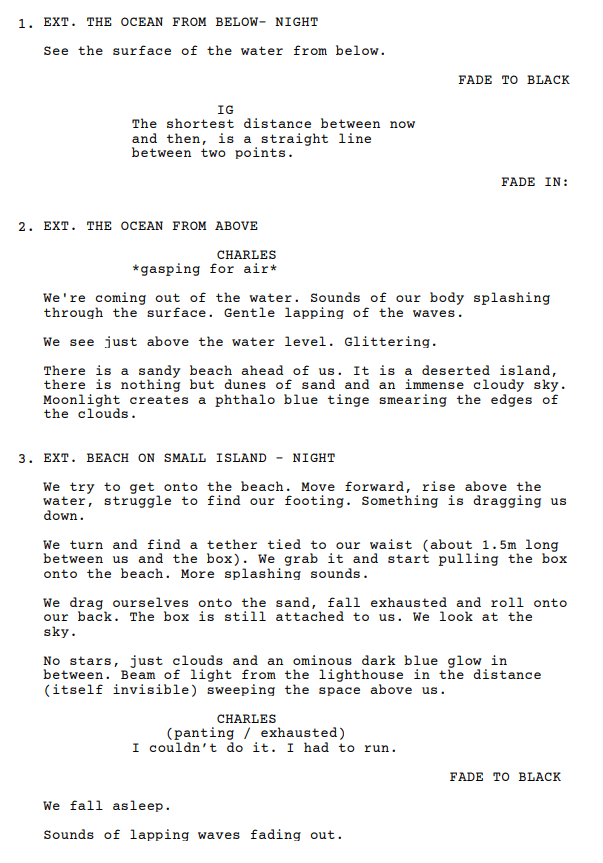
This is the script for the intro cinematic of Fractal Space on PC and consoles. The goal of this cinematic is two-fold: technically this is a mean for the developers to load a very small scene while loading the fist chapter in the background and making the gameflow seamless to the player creating the illusion that there is almost no loading time for the game.
The constraints coming from that are that the intro scene must be very light, few props, long enough to load the first chapter in the background, and not requiring much resources in terms of gameplay mechanics.
Narratively speaking, the goal is to establish a mystery that will hook the player as this intro will be made available in short demos. We want it to leave a strong impression on players, set the tone of the game and establish the first elements of lore and world building.
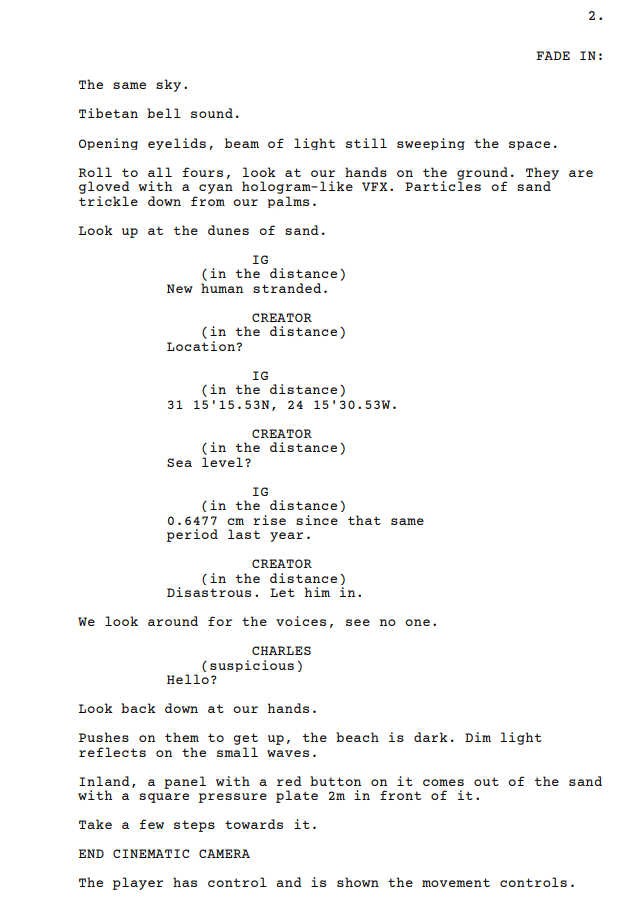
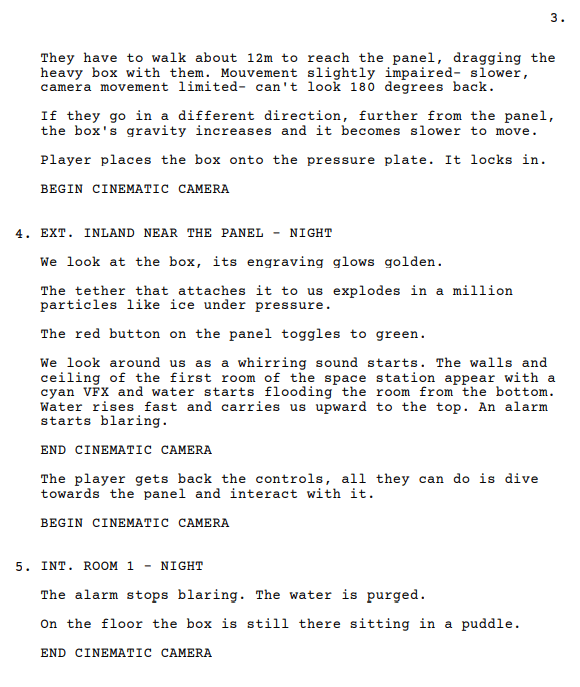
Script page 1Script page 2Script page 3
If you are looking for resources about cinematics:
I use a free software called KIT scenarist, it does everything you need, is very simple to use, and has no script number limitations. I like it.
On the question of when to put cinematics. My take is when you can’t put gameplay and want to limit the player experience to something very specific that you want to be the same for all your players. Ask yourselves and your game designers fellows, would the player want to PLAY that? It’s a game and the risk with cinematics is that players will want to skip them. Consider your target audience and weigh that in. Everything that can be played should be played, that’s why in the cinematic above you see interruptions for gameplay, everything that we could technically, reasonably allow the player to do, we wanted them to be able to do it.
Third tip: we writers love writing don’t we? People who work with us don’t need to love writing, they want this document so they can contribute their own skills and creativity and bring it to life. Be precise but don’t over-restrictive. Be concise, the steps must stand out, the layout of the scene must be clear. This is not the opportunity to showcase your prose, the shorter the better, but it should set a tone.
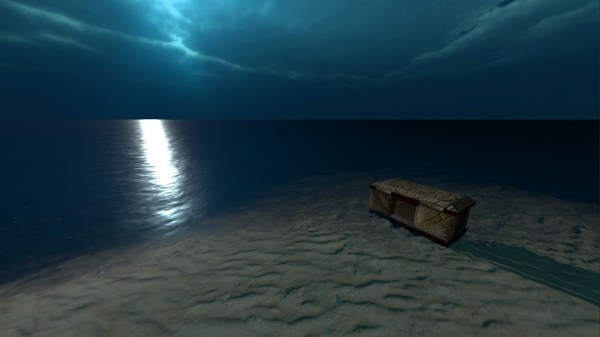
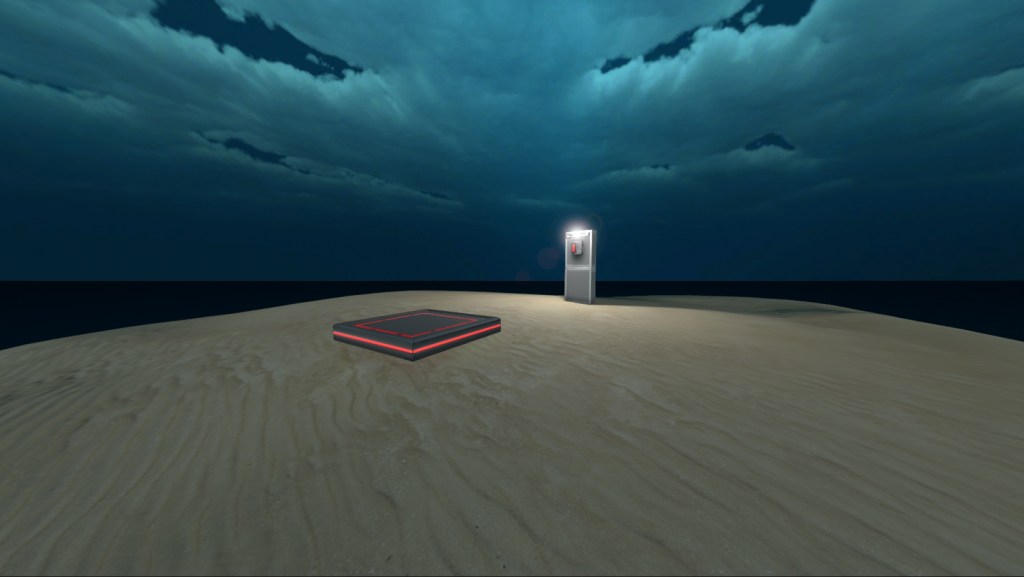
In this example, we want to load very little and the main users of this document are the game designer and the level designer hence the focus on layout and mechanics. In many cases, you will also want this document to go to your art team, so think about what they need to know. Here it is fairly simple: a beach, a box that is detailed in our lore so description is stripped down in the script, a heavy sky, a space station panel with a button and that’s IT. If your scene has more, make sure it is in your script, think about the light, weather, any important props. It will help you define the mood and atmosphere.
Ceres leader, starts as our hero’s ally and will eventually be the one to betray him. Protects and funds Dust’s research in the Belt, organizes the belt military effort.
Region
Ceres / the Belt
Quote
Belters stand united!
Archetype: The creator
Strengths: Natural leader, charismatic, sense of justice, willpower, efficient.
Weaknesses: Lack of recognition, greed for power. Narrow-minded, prevents him from seeing the whole picture, weak body.
Characterisation
Adisa is the first generation of people born in the Belt, from hippie parents who themselves were born on Mercury and fled to Europa when it offered the first settlements, they left behind the caste system and married. His parents were intelligent and kind, they were also full of hope and thought they could seek a life away from the ruses of politics. They believed that inner and outer governments were alike, they didn’t care for the welfare of the common folks and since they didn’t care, they wouldn’t chase those who decided to leave the system behind.
They left with their first daughter and joined a community that preached natural evolution in the Isimud cluster. They studied how to help the body adapt to their new life conditions and conducted several experiments, on themselves and their children in the name of Science.
They learned to move in low gravity, to deal with low pressure, and gradually to get rid of their implants. They lived in small shared habitats, they raised the community children all together as if they were their own and Adisa’s mother was one of the first to bear a child in those conditions, a child that lived. They called him Adisa, the lucid one, hoping he would see through the schemes of power and defend the good.
Adisa was lucid, and as he grew, he understood his parents’ community was an ideal but no one would care, because they were powerless and they all died young. He left Isimud with his own precept “Be good, but don’t be a fool.”
Description
Friendly,
Sick,
Devoted to his cause.
His body is weak, elongated with thin bones, his heart is weak, he has to use various cybernetics to remain relatively healthy.
His ethnicity is multiracial like most outers, showing both African (through his short dense curly hair) and Arab. His back is tattooed with a Japanese koi.
He believes he is the dark side that can protect the pure souls that have found shelter in the Belt, in his belt. He sees himself as factual, reasonable and a necessary evil.
Real nature
In his heart he rages for all the injustices the government maintains in place, he wants to bring them down, he wants revenge for all the suffering more than he wants to bring peace, but he knows that’s not acceptable. He has been raised as a member of a peaceful community and he knows what his heart seeks is wrong. He fights an inside battle to contain his thirst for power and desire for war, a rightful war, until the time has come. Before the belt can fight, the belt needs to acknowledge it is a united nation with rights, a nation that abolishes differences and that considers everyone equal. His ambition doesn’t stop at defending the Belt, he wants the Belt to lead the future of humanity.
To impose himself as a leader he will use brute force and build a massive weapon. He has investigated an old legend from the Belt and found it held truth and clues to an older civilization and the schematics to a powerful weapon.
People will die but they will die martyrs, and he will emerge as the hero that united and elevated the status of all the colonies of the Belt.
More on character design:
I like this one because it was with this character that my mentor taught me about balance. One thing that we writers fear the most is to fall into tropes and stereotypes, so we need tools to help us keep our characters in check and make sure we can bring them depth and details without creating a caricature.
Using archetypes is a necessity for efficiency. There is so much we know and share from our common experience of stories, archetypes create a immediate sense of familiarity, they make it easy for us to relate to them and understand their motivations without having to dive into long explanations of their background that would justify why they feel and act so. I personally like to use the 12 Jungian Archetypes, I guess that’s easily explained by my background in psychology… but you can find endless lists of archetypes online so browse and get inspired.
Be mindful though when writing characters and working with archetypes as some stereotypes can be hurtful and it our responsibility as writers not to reproduce that. First always do your research, second never hesitate to check for authenticity with folks from that community. Get their sense on what might have biased you in describing a character from an under represented group in such a way, they’ll tell you and you will grow, maybe you did not make any mistakes then but talking to the relevant people you will have learned to avoid mistakes in the future. I can’t emphasize this enough, write diverse characters, BUT you cannot possibly think of every question, so research and speak to the right folks about it.
In order to balance out my characters I like to use strengths and weaknesses, they are very short, very easy to share in the character’s summary for the rest of the team and they will give you a good sense of the character depth. If your character, doesn’t have weaknesses, you probably want to get back to the thinking board.
The other thing that my mentor taught me is to split the bio part into 2 parts, especially for the type of game we were working on. He called these 2 parts: Characterization and Real nature. This is intended to give you a sense of your character arc and evolution over time. Where do you come from: characterization, where is that character going: real nature. That aspect of their personality will reveal through the character’s actions in the set of obstacles that you are laying down for them in your game.
 Amélie Beaudroit