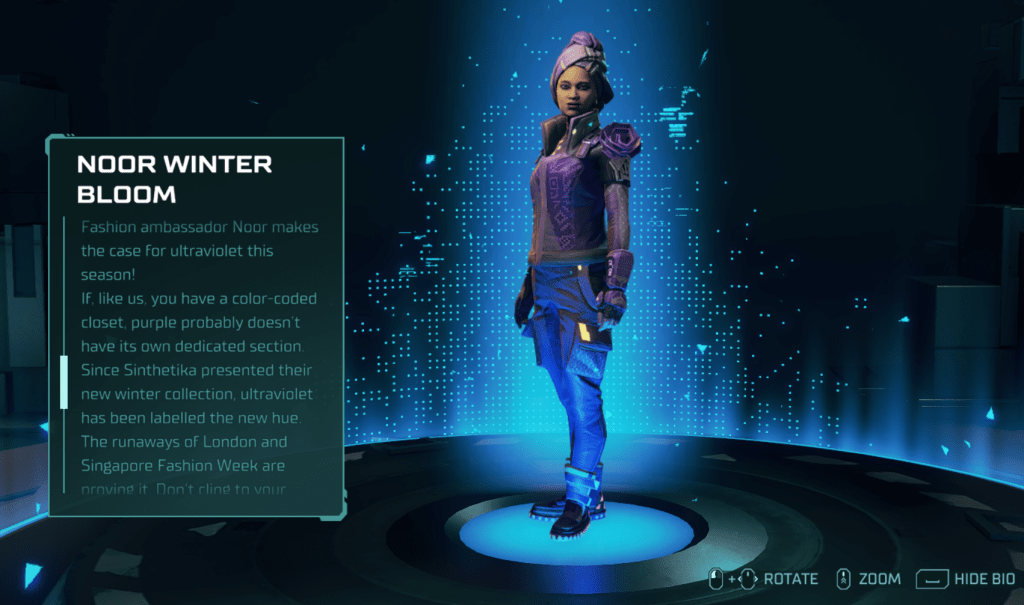
During my time on Hyper Scape I wrote some character bios, tutorials, game mode description texts and a lot of things connected to in-game monetization such as cool item names and descriptions.
Hyper Scape was set in a futuristic universe where everyone could plug in this alternate world and battle for fun or fame.
As writers we put an emphasis on that everyone and pushed hard to create a character cast that was more diverse than everything we had yet seen in this genre. From Myrto a Greek mum who enjoyed playing to spend time with her kids, to Javi a young environmental activist or Adi a programmer from New Delhi, you could play as anyone.
We recorded barks in english and in the mother tongue of each of these characters, giving this battle royale a fresh vibe, where players from anywhere could find someone they related to.
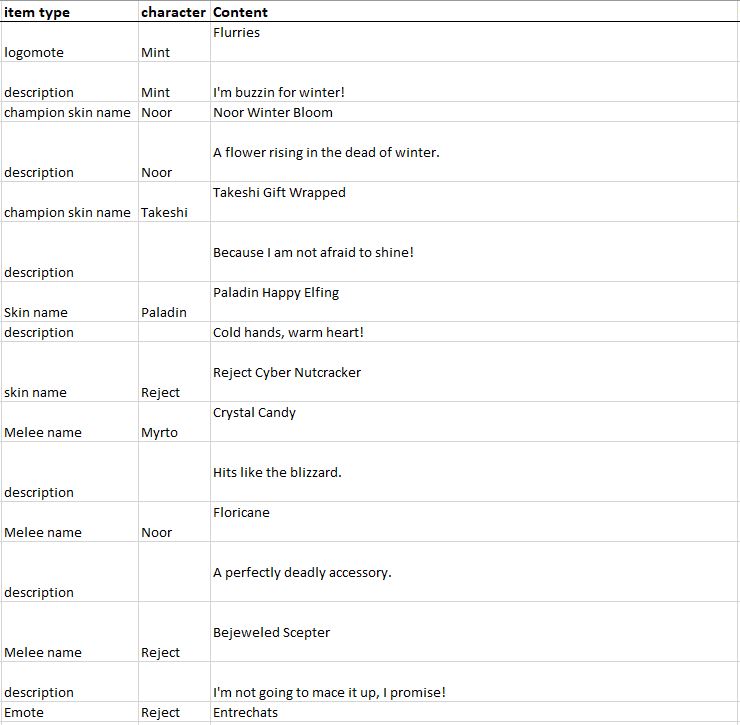
Here is an example of an xls sheet with the list of items I had to write name and descriptions for:
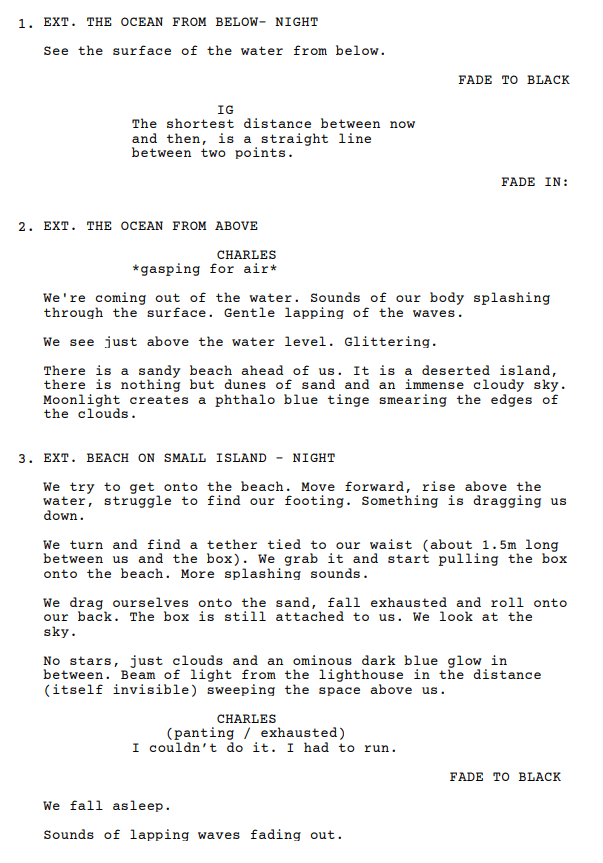
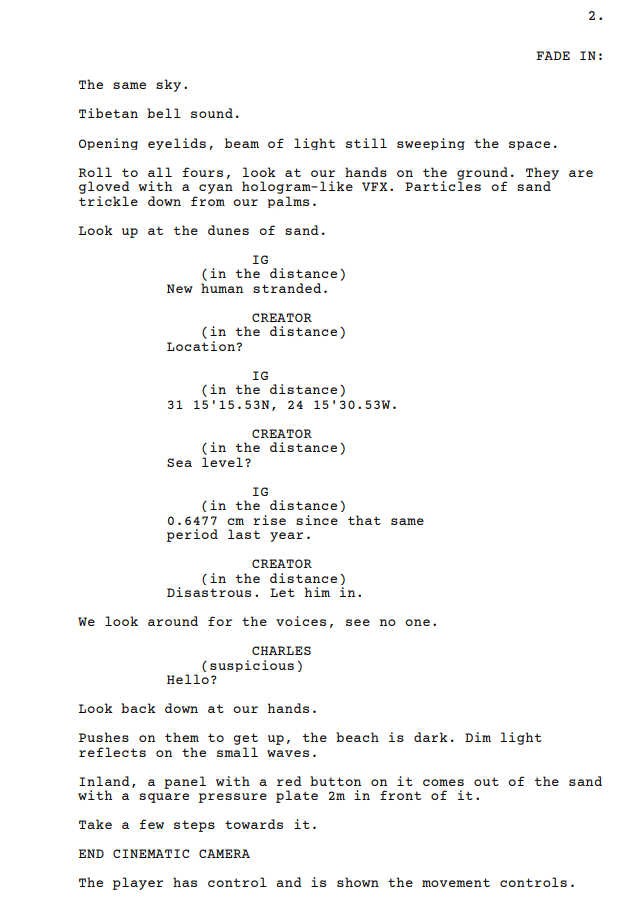
This is the script for the intro cinematic of Fractal Space on PC and consoles. The goal of this cinematic is two-fold: technically this is a mean for the developers to load a very small scene while loading the fist chapter in the background and making the gameflow seamless to the player creating the illusion that there is almost no loading time for the game.
The constraints coming from that are that the intro scene must be very light, few props, long enough to load the first chapter in the background, and not requiring much resources in terms of gameplay mechanics.
Narratively speaking, the goal is to establish a mystery that will hook the player as this intro will be made available in short demos. We want it to leave a strong impression on players, set the tone of the game and establish the first elements of lore and world building.
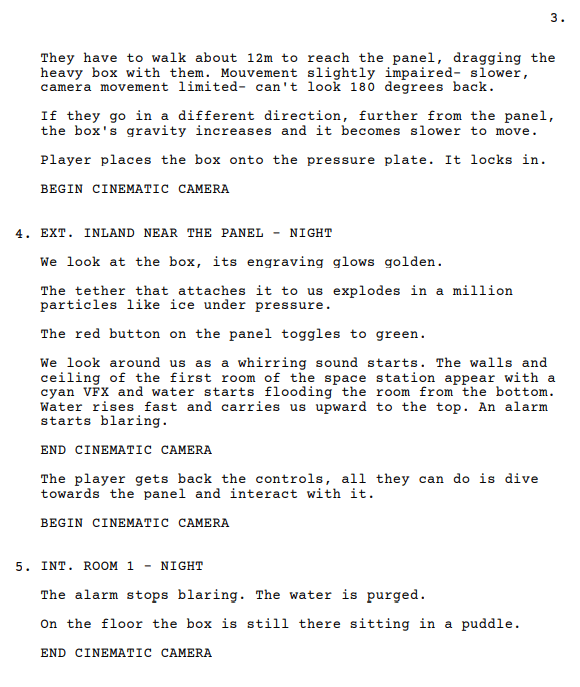
Script page 1Script page 2Script page 3
If you are looking for resources about cinematics:
I use a free software called KIT scenarist, it does everything you need, is very simple to use, and has no script number limitations. I like it.
On the question of when to put cinematics. My take is when you can’t put gameplay and want to limit the player experience to something very specific that you want to be the same for all your players. Ask yourselves and your game designers fellows, would the player want to PLAY that? It’s a game and the risk with cinematics is that players will want to skip them. Consider your target audience and weigh that in. Everything that can be played should be played, that’s why in the cinematic above you see interruptions for gameplay, everything that we could technically, reasonably allow the player to do, we wanted them to be able to do it.
Third tip: we writers love writing don’t we? People who work with us don’t need to love writing, they want this document so they can contribute their own skills and creativity and bring it to life. Be precise but don’t over-restrictive. Be concise, the steps must stand out, the layout of the scene must be clear. This is not the opportunity to showcase your prose, the shorter the better, but it should set a tone.
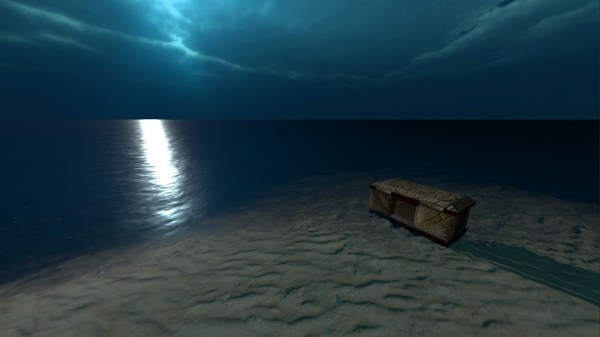
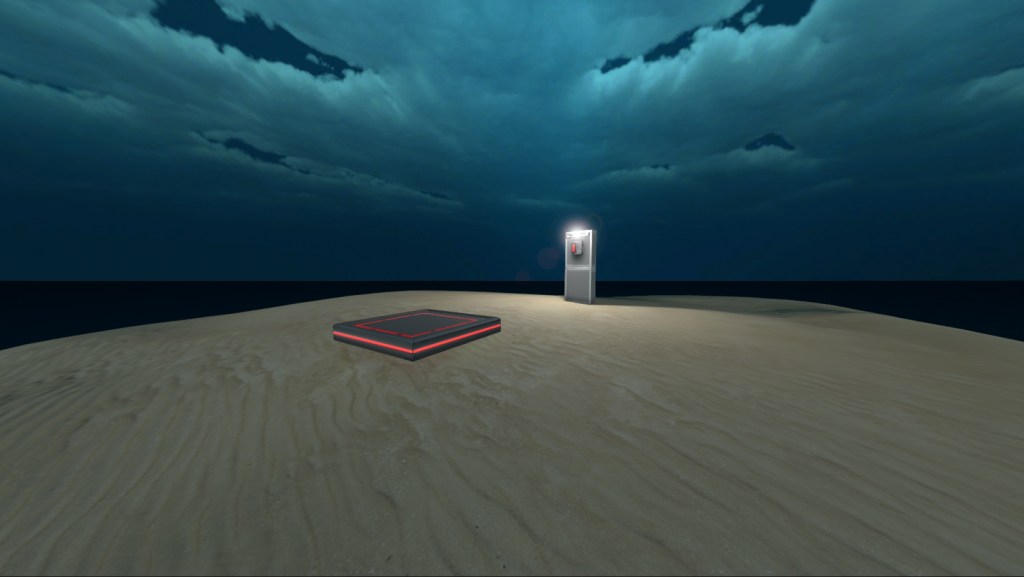
In this example, we want to load very little and the main users of this document are the game designer and the level designer hence the focus on layout and mechanics. In many cases, you will also want this document to go to your art team, so think about what they need to know. Here it is fairly simple: a beach, a box that is detailed in our lore so description is stripped down in the script, a heavy sky, a space station panel with a button and that’s IT. If your scene has more, make sure it is in your script, think about the light, weather, any important props. It will help you define the mood and atmosphere.
Adventure puzzle game, similar to What Remains of Edith Finch
Third Person, 2.5D
PLAYABLE CHARACTER
As part of Pixelles writing program, I created this character for a game concept.
Name: Stella Age: 13 odd human years which is much older in dog years and makes her a sage. Gender: Stella is a female dog. Race/Origin: Black dog, mixed race, looking like a chubby labrador. Important Visual: Stella is slightly cross eyed and she has a limp. With old age, she’s acquired white hairs on her chin. She always wears a collar but her owners change it depending on the occasion, her favourite is pink with bright yellow bananas on it. Affiliation/Team/Organization: A member of the family State: living and communicating in the first chapter, but then a ghost for the rest of the story.
Archetype/Inspiration Character[s]: – Mentor – Fairy godmother Enzo (The Art of Racing in the Rain — for his ability to understand humans’ way and cleverly work around them), Obi-Wan (Star Wars) Stella guides you, teaches you, except she’s a dog version of that noble man and wears a bandana in place of a cloak, Dug (in Up — it’s a plain character and loving, remember the quote: “I just met you, and I love you” Stella shares this extreme fondness).
3-4 keywords (personality traits): – Positive, – Cute, cute and awwww so cute, – Clumsy, – Will devour anything remotely edible (or just smelly)
Wants/Needs/Motivation: Stella reached the end of her journey and passed away. She is totally fine with that and she expects to live in her owners’ hearts forever, except, they are dealing with grief. Stella understands sorrow, and sadness, and grief too of course, but it is not supposed to last, and it seems that for humans it does last much longer than she wished. Their heart has thickened like leather and until it softens again, she can’t rest in there! She needs them to be normal again so she can stop roaming the world as a ghost. For her peaceful afterlife wish to come true, she has to accompany them through the various stages of grief as painful as this is. so their hearts can be soft and open to her again.
Other character relationships: Owner #1 is Henry. Initially he did not want a dog, he’s more of a cat person, but his partner very much wanted to get a dog so after several years he budged, and they adopted Stella. “She’s very big.” was his first thought, but she won him over and 2 months later they were napping on the sofa together and she took most of the space! Owner #2: Eyla is the one who adopted Stella. Initially she thought about adopting a puppy, but when they met, they both knew they belonged together. They go on walkies together and binge watch cooking competition shows.
Summary: The joyful companion
Voice Notes: Stella is an optimist, she does not use sarcasm. She is also very factual in her thinking. She has a problem and she does not worry about the outcome, she steadily works her way towards a solution. At the same time she is not cold at all, she is gentle and caring so her thoughts will always reflect these aspects of her personality.
Quotes: “If you rub my tummy, the world will seem a lot better you know.” “I would never leave you.”
Biography/Background: Stella’s initial journey in life was a tough one. She was adopted on a whim. A present for a girl she grew to love so much. But things went south. The girl left and quickly her owner lost interest in her. They spent days without going out of the apartment. She did her best to cheer him up, but the more she tried, the more it upset him. Once she spilled a bottle trying to get around the coffee table and the couch. Vodka did not taste good. Her owner was furious. One day, finally, they took the car and went for a walk. She was on her best behaviour. She was a good girl, she wanted to run in the forest and roll in the lush grass with him. But they did not. He did not take her back to the car either. She waited. For a while, she roamed in that same area. She learnt to hunt, and then she learnt about traps, not without damage. Later she perfected a better way: big smelly trash cans and how to topple them over. Now she had food, but no shelter. The first winter was cold, the second lonely. It felt very long until a lady caught her, put her in a truck and brought her to the shelter. Food: Check! Clean water: Check. Sleeping out of the rain: Check!! Life wasn’t bad. Someone would take her out twice a week, sometimes they even played fetch.
Until one day, a new lady came. There. With all her heart, she knew it. She was the one. But how to tell her? How to convince her? That night in her cramped kennel she could not sleep, but the lady felt it too and she came back and she never, ever left her.
Strengths: Wisdom, experience, very observant. Weaknesses: Cautious, she’s not the one to usually make decisions. Since she’s a ghost, she cannot be seen and she cannot express herself or interact directly with her owners. A lack of opposable thumbs…
Unique Look, Iconic Weaponry/Ability, or Core Gameplay: Stella has 1 special ability. She can infiltrate her owners’ dreams and feed them, push messages, or images, depending on what information she collected on that day.
Gameplay: During the day she has to find information by solving puzzles and she has to observe her owners and capture moments, things they say, images… At night she can rearrange them while they dream to build a response to how they feel and push it to them in their dreams. If she succeeds, on the next day their heart will be softer, if she fails, it’ll be harder.
Additional Info:
1- Her limp comes from a trap she got caught in during her weeks in the forest. She got out of it but she will never fully recover her mobility. 2- When she runs in her dreams, her owners think she’s chasing rabbits or playing with her dog friends. No she’s not! She’s running after a pizza delivery truck and someone throws her pizzas like they were frisbees! *heaven* 3- She lost a lot in her life, owners she loved, friends, babies. But Stella never stopped loving, not for long. She knows it is when you don’t love that the sun never shines again. 4- When you are a ghost, outside of your loved ones heart, you don’t sleep anymore. She misses sleeping, so sometimes she curls up against them and pretends to nap just to remember how good it felt. 5- Forget nature documentaries, dog videos with ducks or seagulls, cooking shows are the best!
This work was done in collaboration with game designer Robert Halvarsson.
The goal was to define the narrative tools we would use to tell our story in The Mandate. I am not sharing the complete document but just an extract to illustrate what I mean when I discuss narrative tools and narrative design. This step is sometimes overlooked by teams and depending on the project’s complexity it might be fine because the design and the tools are very simple. The Mandate is an MMO RPG, defining the tools was a crucial step to the health of the project. It allowed us to shape the story around the means we had to tell it, and vice versa, because we had an idea of the kind of story we wanted, we defined 2 main categories of narrative tools: missions and events. This document also supports collaboration with Level Designers, Game Designers and Programmers, giving them a reference for when they create missions, events, triggers…
Design Goals The goal for this design is to: – Provide players with a Mission system that is as immersive as possible. – Provide meaningful player choices that affect the outcome of the Missions. – Utilize the gameplay elements we give the players as a method for players to reach their goals.
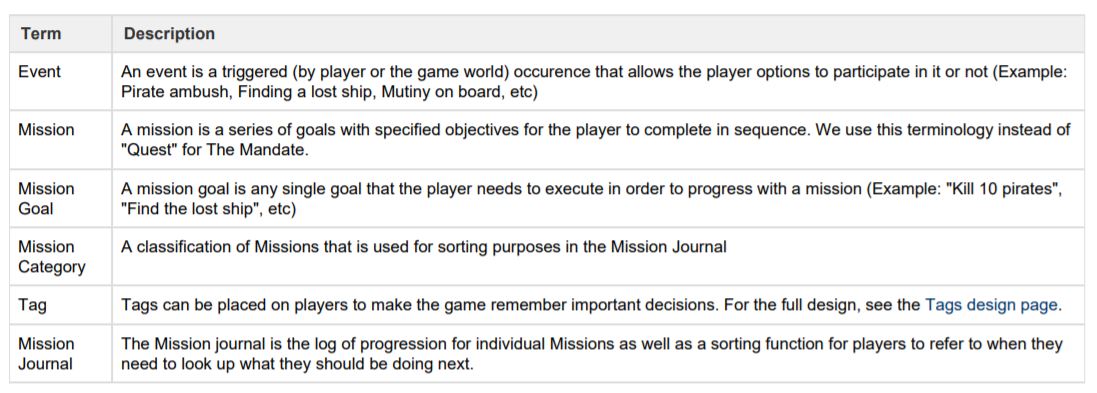
Terminology and Definitions
Summary Missions in The Mandate are more free-form objectives than step-by-step solutions. The player is not dragged by the nose through a series of objectives; rather – a mission is given out with a definite goal in mind and it is up to the player to decide how he or she employs the game systems in order to reach that objective. Missions are objectives that the player must complete in order to gain some sort of reward and the player knows in advance what the mission will get him so he has the feeling of working towards a reward.
Events are things that happen that the player may choose to partake in or not. Events may in turn spawn a mission for the player but it’s not the primary function of the event. Events do not have specified goals in them (although it’s possible to start a mission from an event to provide such goals), nor specified rewards, this adds randomness to the rewards from the player point of view.
Mission Example: The Arkwrights contact the player and ask him/her to destroy a specific starbase. Event Example: The Arkwrights ambush the player in an asteroid field because of the player’s low faction standing with the Arkwrights.
Events An event is a triggered (by player or the game world) occurrence that allows the player several options to participate in it or not (Example: Pirate ambush, Finding a lost ship, Mutiny on board, etc). Events are communicated to the player by the ship secondary in command officer to the player in a short briefing. Where the player gets to know what is going on, and for some events, the player may choose a plan of action (See design for Plan of action) on how to deal with the event. Example: The player comes across a ship dead in space. The briefing states “Captain, we’ve come across a ship dead in space. They are hailing us and are in need of repairs, what should we do?”. The options for the players could be “Ignore them”, “Help them out” or “Destroy the ship”.
Event Types Events in The Mandate are world or player-triggered occurrences that immerse the player in the world – events may be local to a planet, system, cluster or affect the entire world, depending on what type of event it is. Examples of event types (needs to be expanded upon) – Ambush – Distress Signal – Derelict Ship – Rescue Operation – Ship dead in space Each event employs a specific sequence of game actions depending on its Type. These game actions are what actually happens in the world.
Example: An event type could be called “Planetary Distress Signal”. This event type could be the parent for many different things, such as “Solar Storm” or “Lost Expedition” or “Evacuate the refugees” and so forth. Each of these individual events have a list of game actions attached, which affects the world. For instance – the “Lost Expedition” event may start a communicator chat signal with the player where a short briefing of the event is done, whereupon a mission is spawned on the player to save the lost expedition on a nearby planet. In our tool, an event consists of two parts – a Trigger with conditions attached and an Output.
Event Player choices Some events are mere text that will allow the player to choose what to do. An example would be a distress signal that is emitted from a planet, where the player can choose to either rescue the people, ignore the signal, or bomb the planet. Each choice has its own effects and consequences. Dialogue nodes that follow the first dialogue node are possible player choices. These nodes have the player choices available in the “Dialogue Text” field. The Script output field for these nodes are activated if the player chooses this option.
Event Triggers An event may only trigger if certain conditions are met. These conditions may range from the Player having a specific player standing, the existence of a nearby asteroid field or any stat check on the player or his ship. Triggers are set up with a specific chance and repeatability. The chance is a percentage change of the event actually triggering and the Repeatability is how many times the event can be repeated. If the repeatability of an event is set to “-1”, the event can trigger an infinite amount of times.
Mission Fundamentals Missions in The Mandate are different from Missions in many other games (MMO’s in particular) where a Mission is simply a small task such as a delivery, a targeted kill mission or similar. While we may have goals that are similar, the wrapping of Missions in The Mandate will not follow that pattern and instead allow players to forge their own path towards the goal of the Mission. Missions are: – A vehicle for telling the main story/drive the narrative – A way to obfuscate monotonous tasks / grinding via clever wrapping – Immerse and connect the player with the background lore – Push the player to explore new content (areas, factions etc) – Give the player clear direction which is especially important in a sandbox environment – Give ultimate goals rather than step by step details – allow the player to decide how to complete a goal by using existing game systems rather than leading the player.
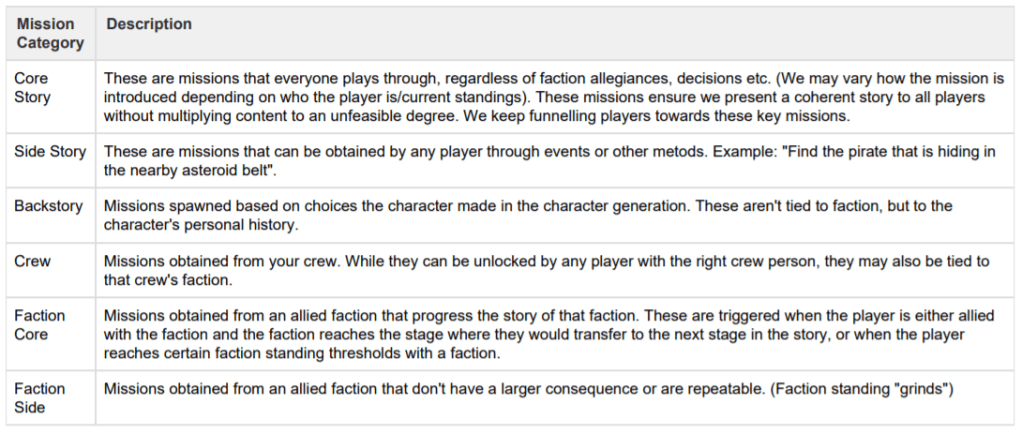
Mission Categories Mission Categories are used in the Mission Journal for sorting purposes.
I started working on Fractal Space about 5 years ago, for the mobile version of a game that was still in development but live at the same time. That was the big challenge, as the developer had released an early version and players were absolutely loving it, BUT there wasn’t really a plan for a story. The developer is leaning more towards C# than prose and he could sense that his game needed a story to infuse some life and a stronger identity into his game so he asked me to do it.
My first task was to understand what players already loved about the game and the universe, then look at the gameplay itself, what are we asking of the player? This allowed me to identify a theme and controlling idea that fitted this atmosphere he had already created. From there, I built a story that would accompany the player through Fractal Space maze of puzzles, provide break when the puzzles are hard, use joke to give him clues and add a layer of meaning to what the player was doing.
Today Fractal Space has 700k downloads on Android only and a 4.7 rating and many players love its original story which, while preserving its lighthearted tone, helps players reflect on the power of choice and the importance of balance in life.
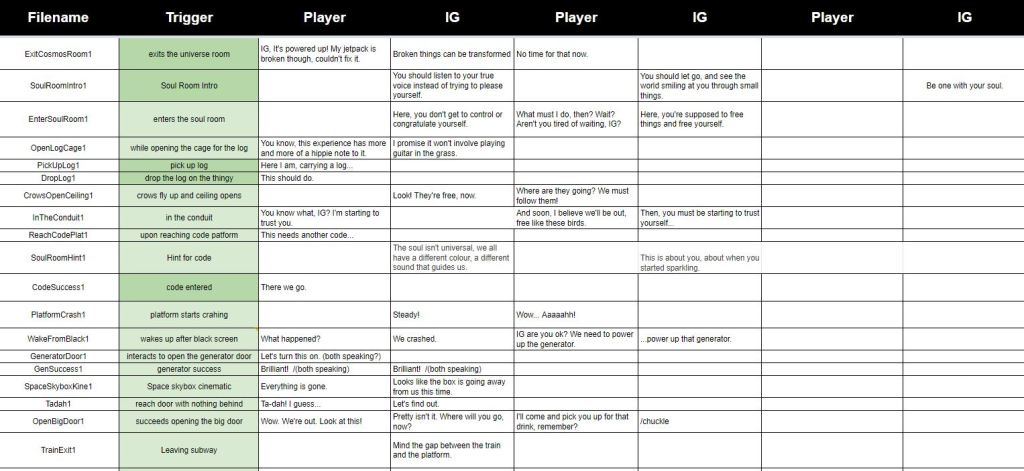
Example of a dialogue in chapter 4Another part of chapter 4
As you can see, the writing part is pretty low tech, what I need to have is a file name, a short description of how or when to trigger that dialogue and then the characters who speak. After that, once everyone has reviewed the lines and is happy, I integrated them in Unity. In this case using a custom system created by the devs themselves.
Each chapter of FS corresponds to a major plot point and has an associated theme that strongly binds the art, the level design and the story together. Our goal is to tell a story without drowning the players in words, to do that we use the level design and the activity or actions we request of the player as a story telling tool. For example, there is a chapter about loops and patterns, the idea here is to discuss how we tend to repeat similar patterns in our life and how that blinds us and blocks our progression. In this chapter, the player goes through a series of rooms that have the exact same shape, but to solve them, he needs to break the previous pattern every time. For the last one, he needs to run in a straight line, move forward, which echoes the very first line of the game and our key message “The shortest distance between now and then is a straight line between two points.”
In FS, level design and stories are tightly knit together and it is their combination that allows us to tell a powerful story of escape, choices and growth.
Time to let the players speak:
5 years after the mobile version, I’m working on a new version of the same story for the PC and console edition of the game, with plenty of new rooms and new player tools. To be continued…
Ceres leader, starts as our hero’s ally and will eventually be the one to betray him. Protects and funds Dust’s research in the Belt, organizes the belt military effort.
Region
Ceres / the Belt
Quote
Belters stand united!
Archetype: The creator
Strengths: Natural leader, charismatic, sense of justice, willpower, efficient.
Weaknesses: Lack of recognition, greed for power. Narrow-minded, prevents him from seeing the whole picture, weak body.
Characterisation
Adisa is the first generation of people born in the Belt, from hippie parents who themselves were born on Mercury and fled to Europa when it offered the first settlements, they left behind the caste system and married. His parents were intelligent and kind, they were also full of hope and thought they could seek a life away from the ruses of politics. They believed that inner and outer governments were alike, they didn’t care for the welfare of the common folks and since they didn’t care, they wouldn’t chase those who decided to leave the system behind.
They left with their first daughter and joined a community that preached natural evolution in the Isimud cluster. They studied how to help the body adapt to their new life conditions and conducted several experiments, on themselves and their children in the name of Science.
They learned to move in low gravity, to deal with low pressure, and gradually to get rid of their implants. They lived in small shared habitats, they raised the community children all together as if they were their own and Adisa’s mother was one of the first to bear a child in those conditions, a child that lived. They called him Adisa, the lucid one, hoping he would see through the schemes of power and defend the good.
Adisa was lucid, and as he grew, he understood his parents’ community was an ideal but no one would care, because they were powerless and they all died young. He left Isimud with his own precept “Be good, but don’t be a fool.”
Description
Friendly,
Sick,
Devoted to his cause.
His body is weak, elongated with thin bones, his heart is weak, he has to use various cybernetics to remain relatively healthy.
His ethnicity is multiracial like most outers, showing both African (through his short dense curly hair) and Arab. His back is tattooed with a Japanese koi.
He believes he is the dark side that can protect the pure souls that have found shelter in the Belt, in his belt. He sees himself as factual, reasonable and a necessary evil.
Real nature
In his heart he rages for all the injustices the government maintains in place, he wants to bring them down, he wants revenge for all the suffering more than he wants to bring peace, but he knows that’s not acceptable. He has been raised as a member of a peaceful community and he knows what his heart seeks is wrong. He fights an inside battle to contain his thirst for power and desire for war, a rightful war, until the time has come. Before the belt can fight, the belt needs to acknowledge it is a united nation with rights, a nation that abolishes differences and that considers everyone equal. His ambition doesn’t stop at defending the Belt, he wants the Belt to lead the future of humanity.
To impose himself as a leader he will use brute force and build a massive weapon. He has investigated an old legend from the Belt and found it held truth and clues to an older civilization and the schematics to a powerful weapon.
People will die but they will die martyrs, and he will emerge as the hero that united and elevated the status of all the colonies of the Belt.
More on character design:
I like this one because it was with this character that my mentor taught me about balance. One thing that we writers fear the most is to fall into tropes and stereotypes, so we need tools to help us keep our characters in check and make sure we can bring them depth and details without creating a caricature.
Using archetypes is a necessity for efficiency. There is so much we know and share from our common experience of stories, archetypes create a immediate sense of familiarity, they make it easy for us to relate to them and understand their motivations without having to dive into long explanations of their background that would justify why they feel and act so. I personally like to use the 12 Jungian Archetypes, I guess that’s easily explained by my background in psychology… but you can find endless lists of archetypes online so browse and get inspired.
Be mindful though when writing characters and working with archetypes as some stereotypes can be hurtful and it our responsibility as writers not to reproduce that. First always do your research, second never hesitate to check for authenticity with folks from that community. Get their sense on what might have biased you in describing a character from an under represented group in such a way, they’ll tell you and you will grow, maybe you did not make any mistakes then but talking to the relevant people you will have learned to avoid mistakes in the future. I can’t emphasize this enough, write diverse characters, BUT you cannot possibly think of every question, so research and speak to the right folks about it.
In order to balance out my characters I like to use strengths and weaknesses, they are very short, very easy to share in the character’s summary for the rest of the team and they will give you a good sense of the character depth. If your character, doesn’t have weaknesses, you probably want to get back to the thinking board.
The other thing that my mentor taught me is to split the bio part into 2 parts, especially for the type of game we were working on. He called these 2 parts: Characterization and Real nature. This is intended to give you a sense of your character arc and evolution over time. Where do you come from: characterization, where is that character going: real nature. That aspect of their personality will reveal through the character’s actions in the set of obstacles that you are laying down for them in your game.
The chronology is an important aspect of the lore that helps the writing team both get inspiration for writing missions, and maintain an overarching consistency in the universe we develop.
3.5 million years ago
TLDR:
Humans lived under the protection of an Alien race
Humans betrayed Aliens and stole a secret knowledge and tech
Humans turned this knowledge into a massive weapon and destryoed a planet
Some of the humans survived and fled
We have lost the knowledge of what happened then and of how humanity developed after.
Humans came to Phaeton from Earth. The fifth planet was inhabited by an intelligent pacifist species who had achieved high technological development. For several thousands of years, they lived a peaceful life. These aliens had a tool they used for travelling, they shared only part of this tool’s secrets with what resembled a human race who had recently discovered their planet and it allowed them to travel faster as well as use long distance instantaneous communication. However, they refused to share the technology allowing instantaneous travel, fearing they would misuse it. Years passed, and the humans grew jealous of the aliens’ knowledge. They started resenting the fact they held knowledge from them so they stole their secret.
They needed a Navigator. Navigators are people born prescient enough to access another dimension and guide the ships to the right location. To upgrade the structure of their port and be able to teleport objects, the humans needed Navigators but it seemed only aliens had this skill. They kidnapped alien children, studied them until they managed to create a serum that allowed them to modify human children so that they would adopt alien characteristics. The aliens eventually realized humanity’s betrayal and grieved their generosity along with a consequence they can foresee but not stop.
As they had anticipated, humans built a canon allowing them to teleport void and create super massive implosions. They destroyed the fifth planet and murdered the race that had been their host for the last millennia.
Today, no one knows if some aliens managed to escape, we only know humans did, leaving their slaves and prisoners behind in the midst of the chaos they created. Planets’ orbits changed, moons fell, meteorites crisscrossed the sky for thousands of years. After their tragic mistake, humans struggled to flee the solar system. The abandoned ones, the low caste that stayed behind flew to Earth. Many died in their ships crushed on the unpredictable trajectory of various stellar objects. Those who reached Earth dug underground cities and lived there waiting for the sky to stop falling.
800 years ago
TLDR:
3 terraformed planets: Earth, Mars and Luna
All scrambling for resources and stations are overpopulated
Political tensions are brewing
Population has reached its maximum on all 3 terraformed planets. Mercury settlement is still not complete and more people than it can host are waiting on orbiting stations. Only Mars has regulated its population and its resource consumption drastically, but Earth which used to be the most hospitable planet now requires oxygen from Europa to be pumped into its atmosphere. Earth has overshot its population growth target and its resources consumption target alienating Mars against them as Martians are forced to take on more and more refugees.
Luna terraformation is underway but in Mars’ opinion it’s costing the system more than the benefits it will offer. A magnetic line, the lift, is drawn from Luna to Earth in order to guide shuttles for sending colonies outer space. Governments agree that the outer solar system is the future and it needs to be conquered to solve this issue. Mars is taking the lead and outer exploration is voted a priority against Venus terraformation, energy corporations are securing government funds to be able to send ships to Jupiter’s moon within 50 years. More and more people are accumulated on generation ships while waiting for a hospitable planet, there is a new generation of people that has never set foot on a planet in their entire life.
700 years ago
TLDR:
Technological advance allows to explore beyond the belt
Resources of the outer world appease a little bit the political tensions between the planets’ governments
Human race achieves faster propulsion making possible the exploration of planets beyond the asteroid belt. We start by sending penal colonies leaving from Mars to Europa and Callisto providing the initial workforce for the Outer Mining Stations OMS. Europa’s goal is to sustain the water needs of the inner planets. Earth is on the verge of collapsing and has stopped supplying Mars which terraformation has taken 200 years longer than expected and which weather is still not regulated to support the water needs of its colonies. The last resources are used to send generation ships beyond the asteroid belt and the first long range ice haulers. The success of the Europa probe ship eased the tensions between Earth and Mars and successful negotiations lead to the first settlement a year after with regular shuttle supplying both planets in water. The resources in the outer world were more than the governments had expected, more probe ships were sent and returned with promising results.
[…]
25 years ago
The outer government has evolved into an oligarchy. A totalitarian regime takes over the inner planets and decides to start mining the Belt for resources they can’t obtain otherwise. An Earther preservation project that scientists have long been working on launches the Arch, the first massive space animal station where 7 animals of every remaining species on Earth embark.
8 years ago
Our player was fighting for the Inner Alliance to protect Deimos and its neighboring stations when it is blown away and his fleet is sacrificed by missiles sent from Mars. The player refuses to die for a government that betrayed him and he flees to the Belt saving the civilians he can bring onboard. One of them is Norma Vacen, an engineer from Khors and her team. The player finds a new home in Pallas, fixes and repaints his ship. Branded a traitor, his crew becomes his family and they can never go home. He finds work in the Belt more easily than he would have thought, legal or almost legal contracts, escorts, deliveries, protection missions. Life is not bad. One organisation has tried to recruit him, Ceres Republik, their propaganda is intensifying, they have started building stronger defenses to protect the Belt, mostly from abusive mining from the Inners They’re always looking for good soldiers and good pilots. But even if they are an anarchic organisation, they’re just another organisation. The player takes contracts from them but he is not pledging allegiance to their group. What did he learn? Live for yourself and for your people, never trust a government to make the right decision, the people are just gun holders to them.
Present time: year 3479
Kaden Doran is taking various contracts to transport resources around the Belt and safely escort civilians. He has no affiliation beyond money.
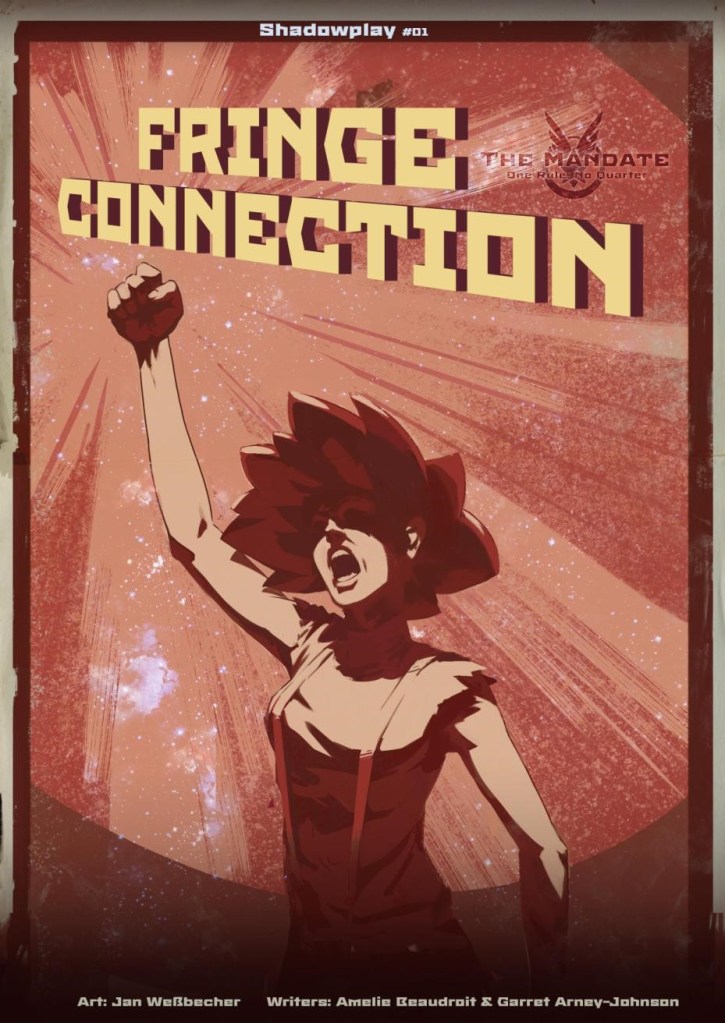
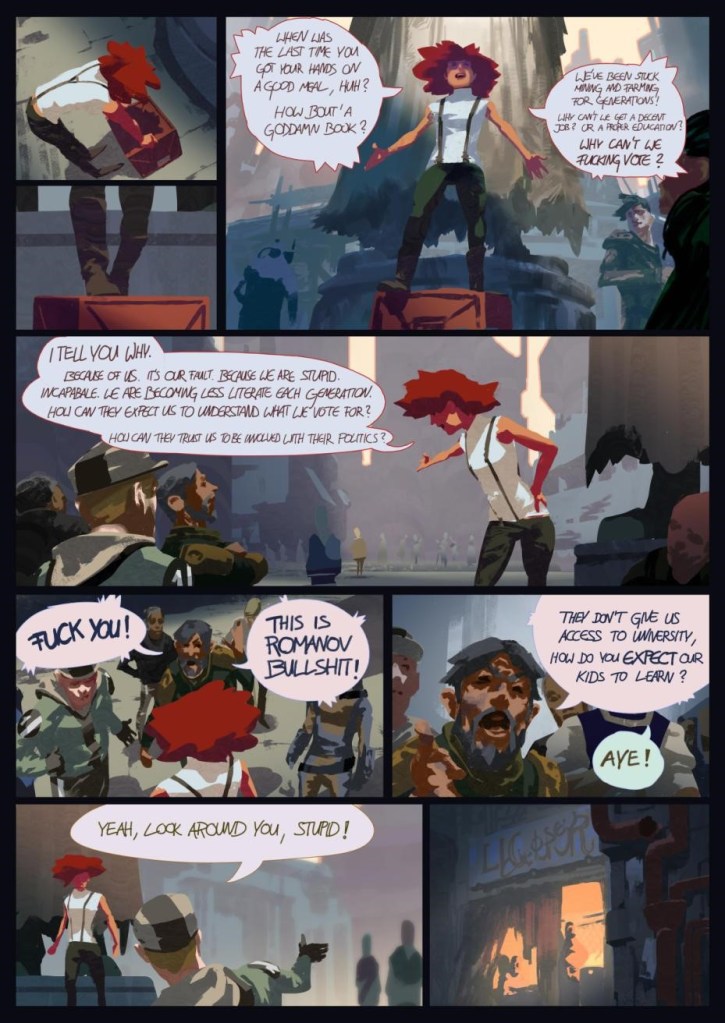
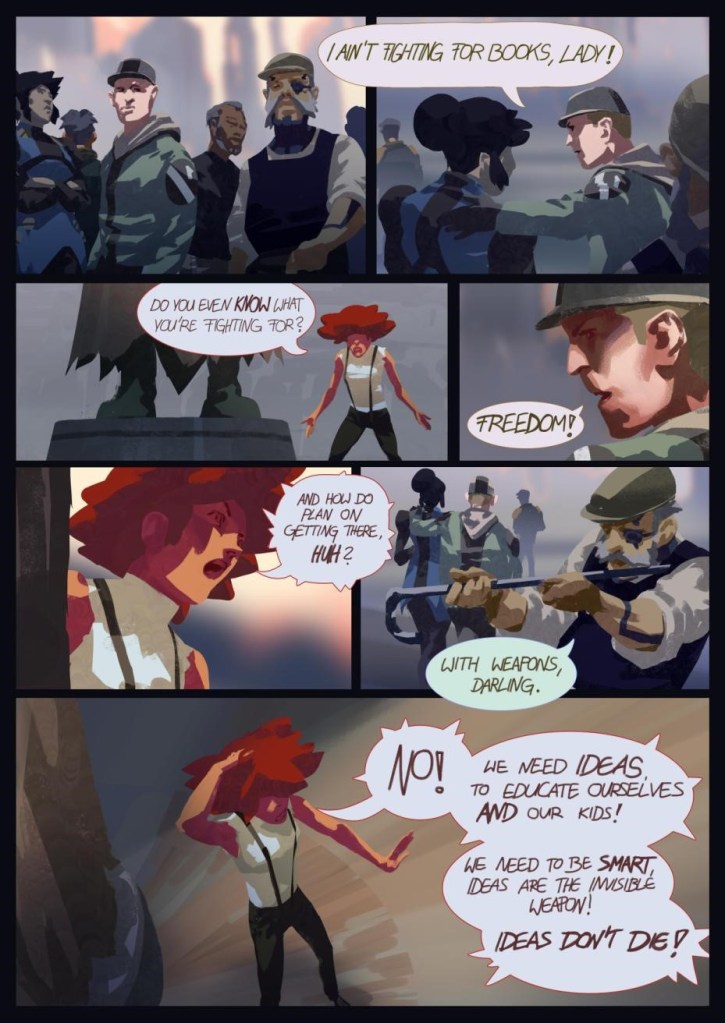
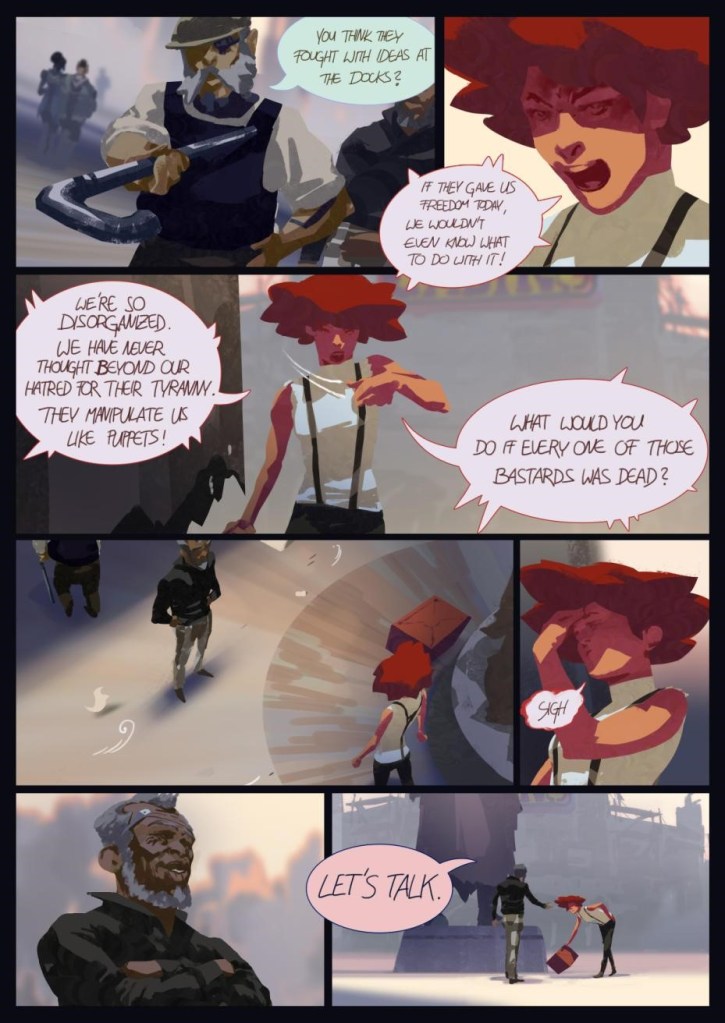
The constraint of this exercise was for each episode to be only 6 pages long. Below is the first episode of Shadowplay, our online comic.
After having validated a summary of the story for this episode with the creative team, I wrote the description and dialogue of each panel before sending it to the artist who would add his input (in red in brackets below) on how to depict them. We would iterate and agree on this document with our art director before starting the storyboard phase.
After I worked on the comic book and user research for this project, I took on more writing and narrative design tasks including character bios and an update of the main story arc. Later on, I developed missions and lore to fit the new art direction taken by the project.
Julia
“What in Suvarovs underpants is that? Is that..? It is! It’s a Mark II Arkwright Battlecruiser! I’ve only heard about them – rumored to have impenetrable IDF shields. Coincidentally – much like Suvarovs underpants I suspect.”
Motivations
Julia McIntyre is the player’s friend from the prologue. She’s a free-thinker, cheeky soldier who joined the Mandate corps because erm… free travel? She didn’t care for the cause, but her lust for adventure couldn’t be quelled, and this seemed like an exciting enough opportunity. She doesn’t particularly trust the Mandate or the Empress nor does she care for the chaos of the rebels or the greed of the pirates. The only one she is fiercely loyal to, is the player.
Words that describe Julia
Carefree
Fun-loving
Loyal
Brusque
Honest
Unafraid
Foolhardy
Background
Julia has always had a problem with authority.
When she was young, she lived on Victoria, in one of the many cities that cover the planet. Her mother was always a bit of a wild one, and she ran off when Julia was five to join up with a band of space pirates, leaving Julia to be raised by her father, a quiet man who didn’t know what to do with his high-spirited daughter.
She joined a street gang, mostly out of boredom. Their leader grew nervous of her recklessness, saying she was going to get them all arrested. This came to a head when she arranged to steal the Blackstar Diamond during a speech given by the Europan delegation on how to minimise the environmental damage done to the planet. The Europan’s brought the diamond as a symbolic gift, meant to symbolise a clean start, a fresh approach to environmental affairs. Julia stole it. And dumped it in toxic waste as a message to what she saw as “empty promises and hot air aimed at distracting everyone from the terrible conditions under which we all live.”
The leader of the street gang wasn’t happy with any of this, but Julia challenged him and took over the gang, turning it into an infamous criminal enterprise.
Soon she realised she had done everything she could on this planet. She took after her mother, and her gaze was drawn to the stars. She wanted to see the galaxy. To explore. To meet new people and bask in the sunsets of a thousand different worlds.
Unfortunately for her, being the leader of a gang would never buy her a ticket out of Victoria. However, the Mandate corps would and that’s how she joined. “Free travel, eh!”
What Julia saw as her sense of adventure and lust for life soon earned her a reputation as a brave (or foolish, depending on whom you asked), risk-taker (or a danger to those around her, again, depending on whom you asked.) She worked her way up to a Captaincy and was put in charge of a fully-staffed ship.
During her first month as captain, she was involved in a battle with the rebels. Her ship had been hit by a focused EMP burst and it lost all power. Her crew was dying slowly as the oxygen pumps stopped working when the Player led a team into her crippled vessel and saved her crew, getting them to safety first (at her insistence).
Sadly, the rebels had boarded the ship by then. Julia told the player to leave her behind, but he refused. He went back on his own, and he and Julia fought their way through the ship, killing rebels as they went.
Since that time, she and the Player have been very good friends, (of the bickering/bantering kind) but don’t let that fool you. They would die for each other.
More on this character:
Julia was my very first character design before I started getting mentoring and taking writing crash courses. She is a character written with intuition and based on the needs of the team. What did we need to know when we started working with her? We needed her role and we needed to know how she would sound, what was her tone and personality like. We wanted a badass, unafraid rebel to incite our player into action and that’s exactly what Julia does. If you compare it to the later characters that I wrote you will see that she does not have the 2 parts bio, she does not have the archetype explicitly yet, although she is very clearly the outlaw. You find both her strengths and weaknesses in the descriptors.
So why changing the format of the character design over time and why putting inconsistent formats in the portfolio you ask? Ha-ah! Because, it’s good to be a writer and to think about consistency yes I promise I do that too, but when you’re a game writer your main goal is to be part of the team, especially if you work for indie companies, you need to adjust to what they need. You don’t need to compromise the quality of what you deliver, but if your document is so long that no one else in the team will read it, what are you compromising there when you do that. Writers must show flexibility! We’re often seen as the romantic, imaginative loners of the team, we’re often introverts, we like to communicate with documents more than in big meetings and when we’re asked when it will be ready it seems to us like a crazy question but we’ll give them something. All this may very well be a stereotypes but even if you’re an extrovert, adapting so that your communication is spot on is key in game writing, so don’t stick to one character design format, work with what works for your team and create a collaborative document. It is the form, what matters is that you convey the content!
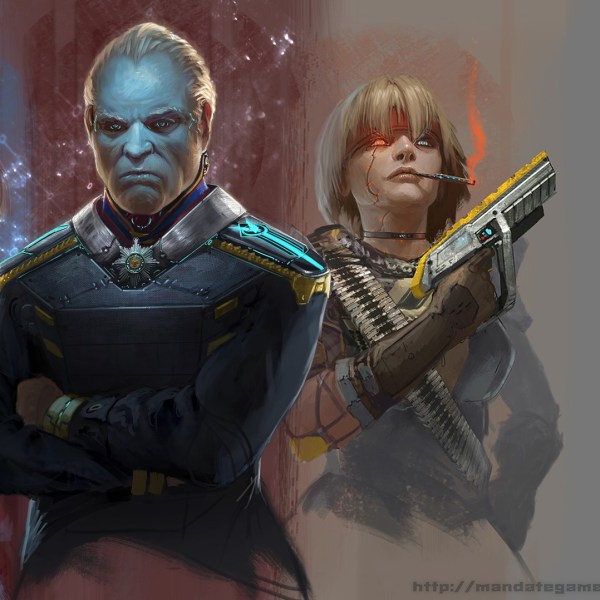
I defined with the creative team the themes and the controlling idea we wanted to develop in 50 AU, a space opera RPG. The goal was to identify a theme that would fit a gameplay focused on large space battles and an art style that mixed high-tech gear with the future of piracy.
The themes that emerged were around geopolitical conflict and the search of a new habitable planet. This goal was set by politicians years and years ago, before humanity developed its new space identity, and it was never updated. In the current day of our player, a single planet could never sustain the whole of humanity as it grew after generations of space exploration.
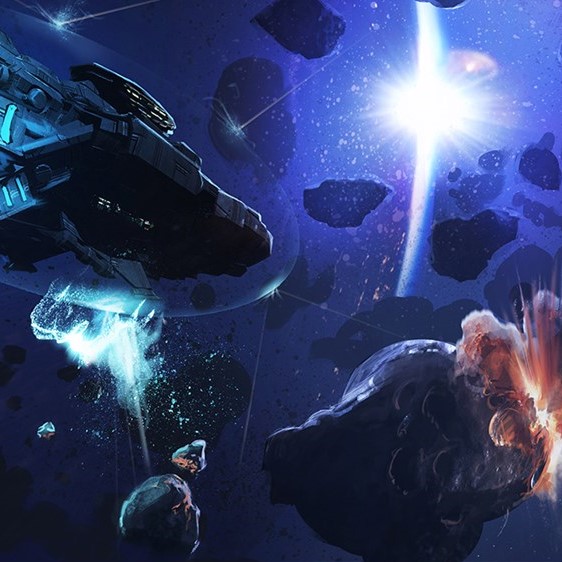
This provided us the setting for leading our players into massive space encounters and skirmishes alike.
2 quotes helped us build the themes for the game:
“Every organization rests upon a mountain of secrets” – Julian Assange
“Whoever fights monsters should see to it that in the process he does not become a monster. And if you gaze long enough into an abyss, the abyss will gaze back into you.” – F. Nietzsche
The controlling idea for our story was people federate in larger and larger group, power dynamics emerge and corrupts those systems, derailing them from their initial good intentions.
I used values from the table below to ensure consistency in our story.
People can be trusted
Middle size organisations can sometimes be trusted but you’ll find out they had a personal interest in it that resembles one of the governments
Individuals who look like people but are part of governments look like they can be trusted but they cannot
Governments cannot be trusted
Values arranged on 2 axis: trust – distrust and individual – government
The goal of this table was to help us ensure that no mission would contradict the controlling idea, while giving us a framework to develop a variety of characters and missions that would illustrate the concept in each cell.
Once this step was done, I went on to write the story arc with the main plot points, then I detailed each mission around its role in the main story arc.
Below is an example:
Plot point
Location
Type
Mission steps
Key sentences
Starting point
Deimos and the belt
Cinematic
PP1- Player works for Earth government. PP2- sent to a conflict PP3 – realizes his crew has been sacrificed and him betrayed PP4 – escapes with his crew to the belt PP5 – branded a traitor becomes a smuggler
Those ships… no those ships aren’t Martian…
Mission 1
Belt
Exterminate
Because of resources issues some inner ships are mining the belt, The belt is a neutral area, nobody is supposed to exploit it. You are asked to find who is doing it Your main character recognizes inner markings and inner ships in an outer belt area. No pity, you have to burn them down, they just shouldn’t have come
Fucking inners! Like they haven’t screwed us enough, they think they can come and mine here, and nobody will fight them off. I say we teach them a lesson!
Mission 2
Saturn
Delivery
A rumor from years ago says the rebellion on Deimos was staged, by a corp wanting to break free from the inner government. Player takes a contract for the corp after saving one of the scientists in the team. The ex-Martian corp is paying you to retrieve a package from the outer and deliver it to one of their new station in the belt. Player learn about Martian mentality Fight pirates to deliver package and head off to Saturn.
Martians! Land of queen bees, we could give them the best of the moons and it still wouldn’t be enough!
Mission 3 Inciting incident
Jupiter trojan
Boss
Delivery mission for Ceres. Taxi the scientist from one asteroid in the trojan back to Ceres. Meet Dust and learn about the fifth planet destruction and that Kuiper’s confederation tried to kill her. Pick her up, fight off Outer ships, intel about the Ancient civilization and the technology that destroyed the 5th planet. Kill the boss and go home. The boss here is a Kuiper sergeant that has managed to track her in the trojan which is Kuiper territory, he’s calling her a traitor and asking our player to deliver her to him. Because of your own history with the inner government you know what they mean by traitor, they threaten to attack your ship and won’t back down so you destroy them.
Long before us there was a fifth planet, a peaceful civilization, an ideal world, and someone came to blast it away leaving chaos behind them.I will find out why!
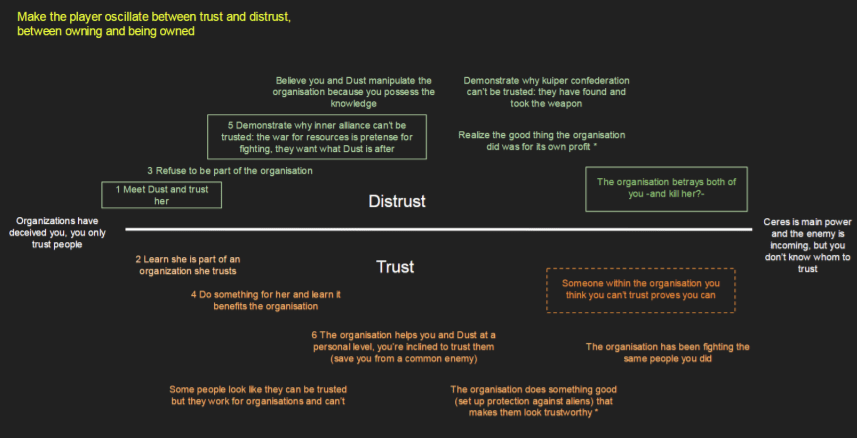
Below is a sketch that summarizes the balance between missions where the player feels trusts or distrusts as this is the main sentiment we want to manipulate to build tension and emotion in the story.







 Amélie Beaudroit