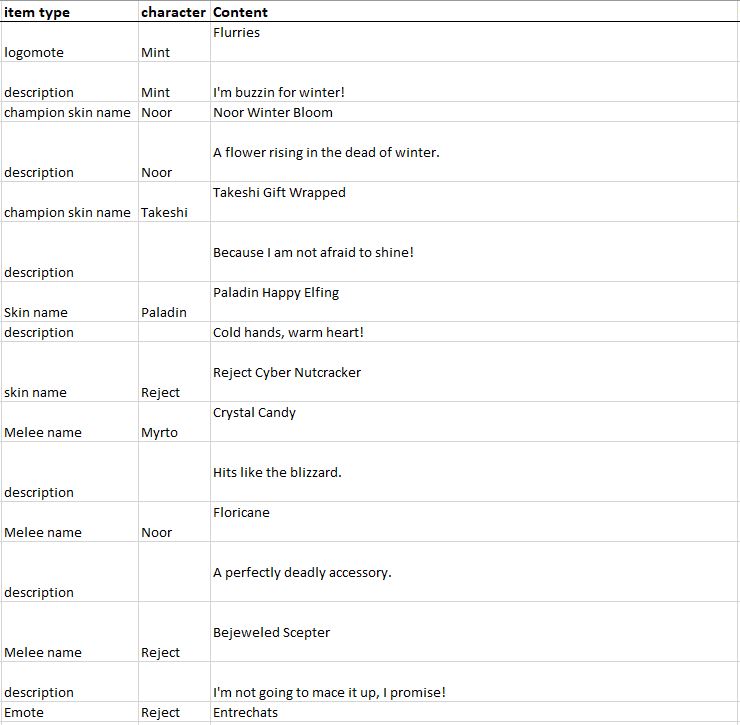
During my time on Hyper Scape I wrote some character bios, tutorials, game mode description texts and a lot of things connected to in-game monetization such as cool item names and descriptions.
Hyper Scape was set in a futuristic universe where everyone could plug in this alternate world and battle for fun or fame.
As writers we put an emphasis on that everyone and pushed hard to create a character cast that was more diverse than everything we had yet seen in this genre. From Myrto a Greek mum who enjoyed playing to spend time with her kids, to Javi a young environmental activist or Adi a programmer from New Delhi, you could play as anyone.
We recorded barks in english and in the mother tongue of each of these characters, giving this battle royale a fresh vibe, where players from anywhere could find someone they related to.
Here is an example of an xls sheet with the list of items I had to write name and descriptions for:
If you have played any type of video game, you have encountered what we writers call Barks. Yes, in games every character barks, not just the dogs and no, barks are not throwaway lines, maybe we’ll talk about that in another post.
Barks are very unique to game writing. In other media: books, films, plays, everything is scripted. Therefore, you can plan every line a character will say, and nothing is left to someone else. In games though, the player has control of… let’s say a good number of things. Depending on how much your game is linear vs open-world you will need more or less barks, but they are still generally a very common task that writers have to tackle.
So why do we use barks? They fulfill 2 essential roles: – Providing players feedback, on their progression, on the dangers in their environment, on the game states…. – Adding flavour to our world: building the fantasy, the lore of the game, creating the vibe and conveying our characters personalities.
Barks are the game talking to you about your performance, about your objectives, or about the world you are in, and doing it with its distinctive voice.
Think Death Stranding, Sam walking alone talking to himself: “Sam, Sam, he’s our man!” or “Here we go again.” These barks embody our main character’s personality, they emphasize his sense of isolation by having him talk to himself. They encourage you to literally carry on and they give you a sense of Sam’s personality and sense of derision. Or think Starcraft and how Protoss barks differ from Zergs: “I feel your presence.” “I hear the call.” “Our duty is eternal.” This is so totally Protoss vs “Metamorphosis completed.” “For the Swarm!” “I will take essence.” Totally Zerg.
In any game that has actions the players may repeat, and / or where writers can’t predict when in the story the player will do them, that’s when we write barks. Think about any shooter game you might have played, you will always need to reload. We want to let players know they are running out of ammo, so we use barks. Barks in that context need to be short and efficient and not distract the players from what they’re doing or become so repetitive that they will annoy you. There are different ways to convey that information and each has a different flavour. They give us an opportunity to distill a little bit of the character’s personality or the world’s fantasy. You could say “I need to reload” or “I’m out of juice” if the weapon is an energy gun or “I’m dry” and they all mean the same thing: the player needs to reload but they taste different.
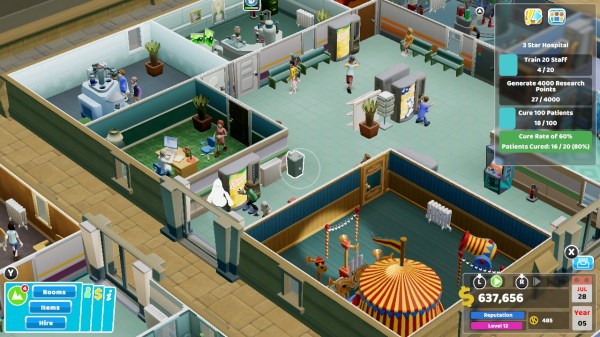
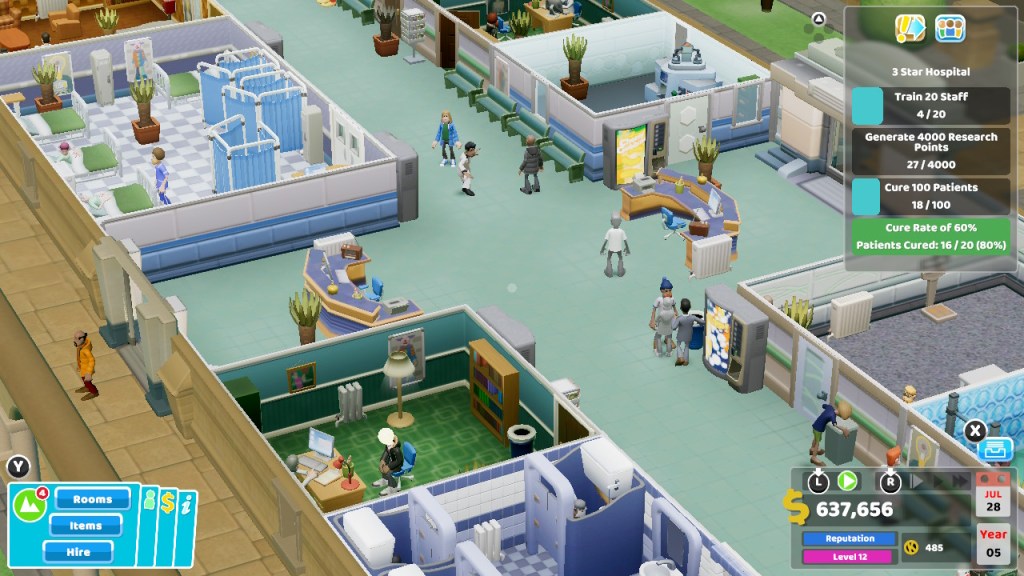
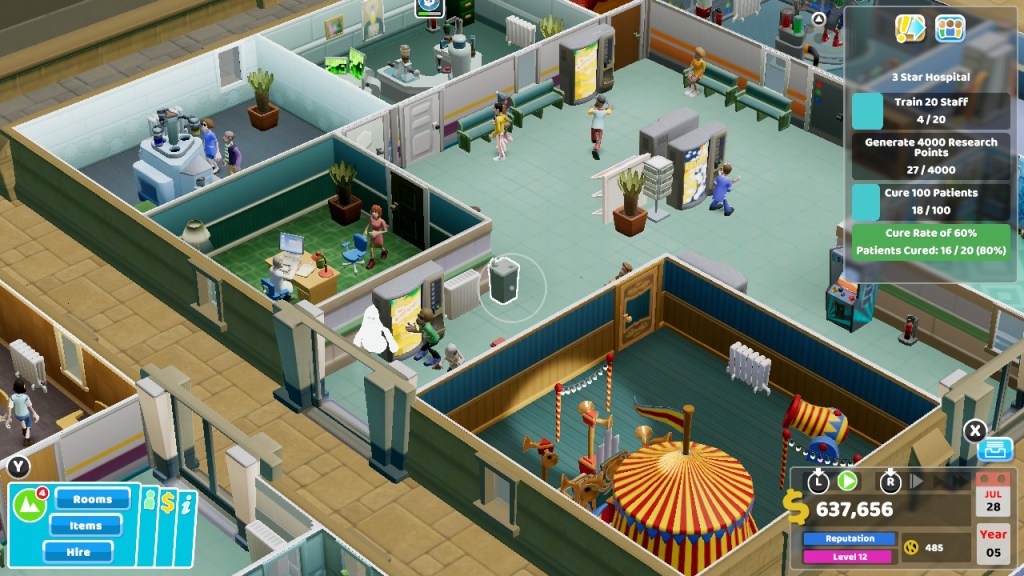
These days I’m playing Two Point Hospital, and this game has very unique barks that participate a lot in making the game what it is. The game does not have a storyline, but it does not mean that it is not immersive or doesn’t have lore, and that’s achieved through the art style of course, but very much so through the barks as well. In Two point Hospital, the character giving you feedback on how well you’re doing and on what’s currently happening in that mad place is Tannoy, our PA announcer. Let’s look at a few of my personal favourites:
“Attention! Don’t feed the ghosts, they’re dead. Thank you!”
“Automated food machines need filling manually.”
“We’re sorry about the litter, that you dropped on our floor.”
“There’s a fire. There shouldn’t be a fire.”
“VIP arriving. Please prioritize their amusement over patient well-being.”
Even if you haven’t played the game, reading those lines will give you a sense of the game mood. It’s humoristic and it’s not a realistic simulation game. You can expect crazy illnesses and funny looking patients. Each of the lines above serves 2 purposes, the tone like we discussed and player feedback.
The first bark lets you know that you have ghosts roaming around the hospital. If you had not seen this because you were busy building and furnishing new rooms at the other side of your estate, you might want to have a look and possibly assign a janitor to take care of it before the ghost drags your patients screaming outside.
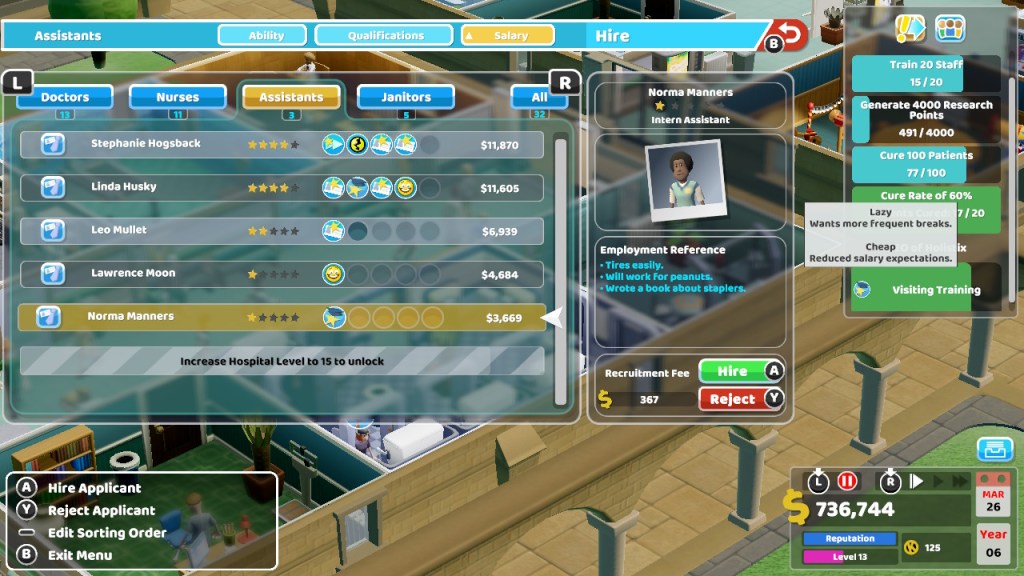
The second one is a warning that some of your automated machines are empty and need restocking, but again the way it’s written (and the way it’s voiced) contributes to the tone and the game consistency. I could go on like that with each of them. Barks are real writing, don’t ever turn down an opportunity to work on that! In Two Point Hospital, they are like the binding agent of the whole game experience, because they are voiced and the rest of the text is written, meaning it’s a lot less certain that the player will ever bother reading it. If you manage to express the game’s personality through the barks, you may very well light the spark that will make the players want to read more about what’s written in the game. Of course Two Point Hospital’s writers have done the job perfectly and you will not be disappointed if you pay attention to every single piece of text that populates the UI. Barks are just one element of lore, the one that is the most accessible to the players, but every other piece of text is written with that same sarcastic zing. Characters’ descriptions in the hiring UI will tell you that this doctor “Will work for peanuts” or that this assistant “Thinks their life is a romcom” or that this nurse is “Hangry”.
Depending on the game you’re making, barks may well be what the players will hear and remember the most from their experience, because they are tied to actions that they will repeat over and over. They may seem like an detail, but Two Point Hospital shows how they can capture the atmosphere of your game and contribute to making it more fun for the players. Of course, humour applies in their context and their barks can be longer because the gameplay can tolerate that, while it would be much more complicated in an action or stealth game. Still their barks focus on doing these 2 things and they do it very well: Feedback + Flavour.
Barks will often stretch our creativity because we think there are only so many ways to say “reload” or “enemy there”, but if you think about it in conjunction with delivering game vibe and fantasy, you’ll see that it’s not just what you’re saying, it’s how you say it! A handy skill to have, both in game development and life.
I hear people say “it’s a love it or hate it game.” I am not sure. I loved it and it frustrated me to a painful level at the end because it did not give me a sense of closure.
You have to love story for the game to hook you, because at the start, that is pretty much all you get. For the first 2 hours, gameplay is sparse, but the cinematics are dramatic, and the world breathtaking. Having watched the trailers before the release, I expected nothing less. Instantly, I dive into a world where life and death are carefully intricated. Whatever happened, it plunged civilization into a post-apocalyptic gloom and the living are staggering to recover.
Fragile is one the first NPC we meet and she introduces us to the lore and its rules, Timefall, Cryptobiotes, Chiral Allergy. There is a lot to memorize and pay attention to, but Sam and I are fully dedicated to our task. After meeting with the threat and getting out intact, I am given a baby in a bottle for company and to help me anticipate and prevent my next encounter with BTs (Beached Things, specters that are left stranded in the world of the living) but the pace lets me down. For the next 20 hours, the story I am introduced to takes the back seat and I am left to starve. So many questions have been handed to me, I had to understand what the hell happened on that beach. Why was I a Repatriate (someone able to come back from the Seam, a mysterious beach that joins the world of the dead and the living)? Why is the world ravaged and people scattered, disconnected? Mostly, how do we solve this?
As I progress, I’m only given more questions, characters’ arcs start to pile up with every new NPC: Die Heartman, Amélie and her cause, Cliff and his nightmares, Big Mama and her BT baby. I have more and more questions to memorize and I struggle to connect their individual stories while my main plot, the initial incident, the cause of the Death Stranding stalls and the stakes are slipping away from me.
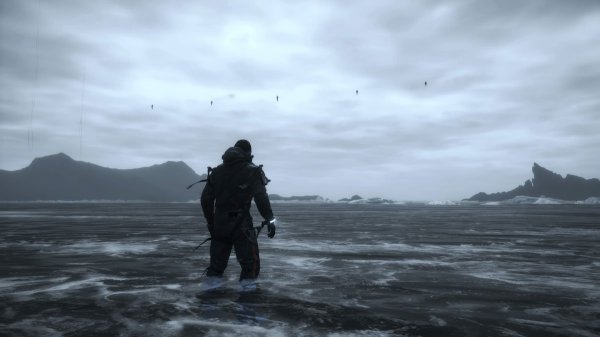
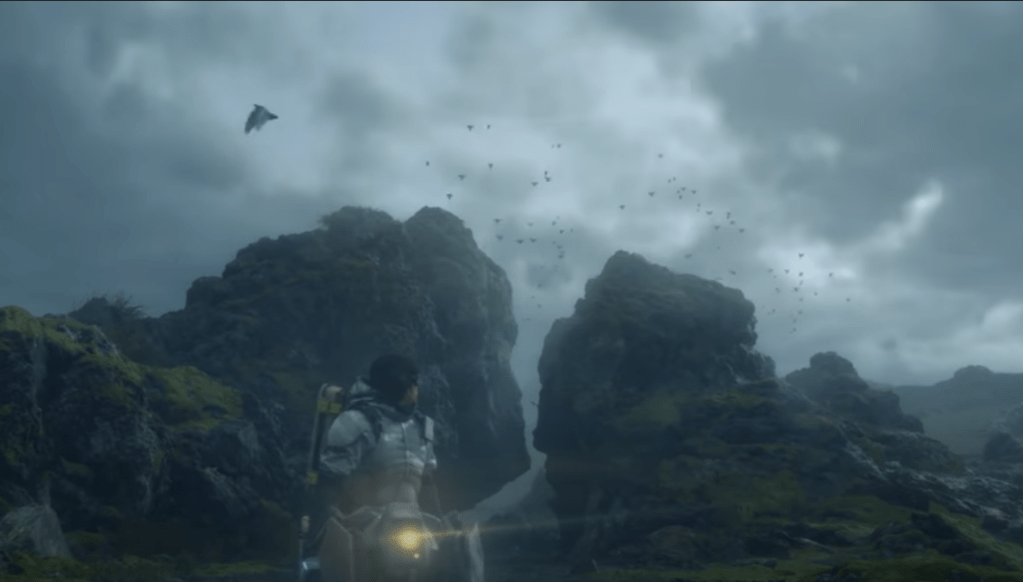
Sam and the crows fleeing Timefall
In total it took me a bit more than 50 hours to finish the game. I did very few side missions, I strolled, I hate vehicles so I barely used them. Here, in real life, we were in lockdown, I love to hike, this was perfect, it was my escape, the music was powerfully atmospheric, the landscapes reminded me of the highlands and my beloved Skye, the immersion was total, the mystery of the beach hooked me right up from the start. The game, as compared to what exists today on the AAA market, has very little violence in it, it has a dark background story that is slightly (erm) reminiscent of the ecological crisis we are living through. I related to it and I related to Sam. I’m an introvert, I like to be alone, I like to walk in the wild and let my thoughts carry me away until I reach a summit and pause to absorb the beauty of it with great relish.
If I am not the target audience, who is?
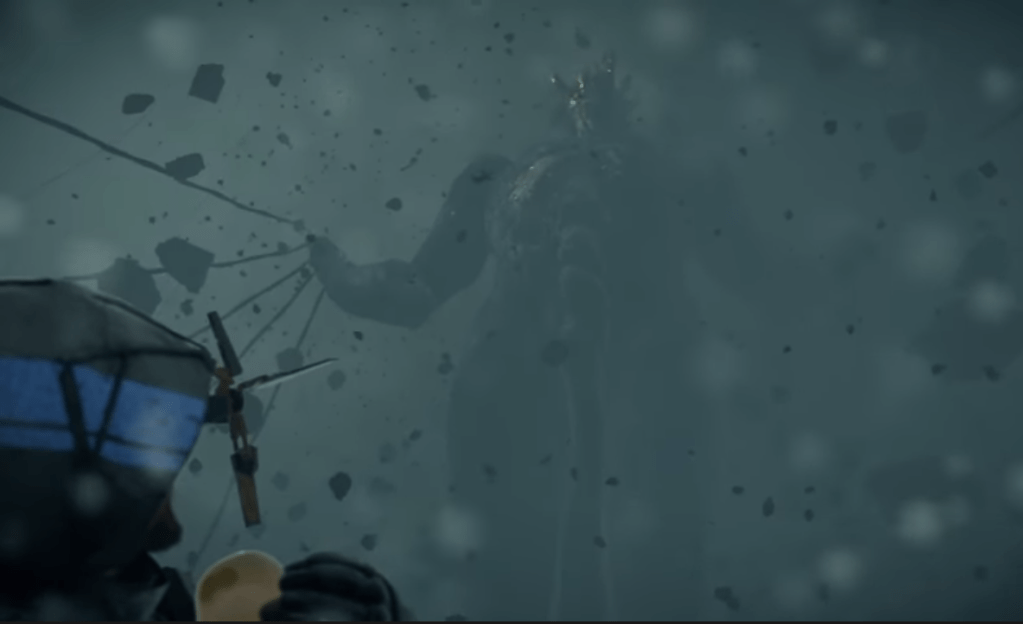
The first 10 hours went like a charm! I was back in the mountains, alone, in peace, I was doing good by delivering neatly packed gears to folks who needed it. There was a wonderful character that I got introduced to with a slick umbrella, and together we held our breath to hide away from this unknown, strange and gooey thing that tried to kill us. This giant handed creature perfectly incarnated the ecological nightmare that awaits in the dark, where no one wants to look.
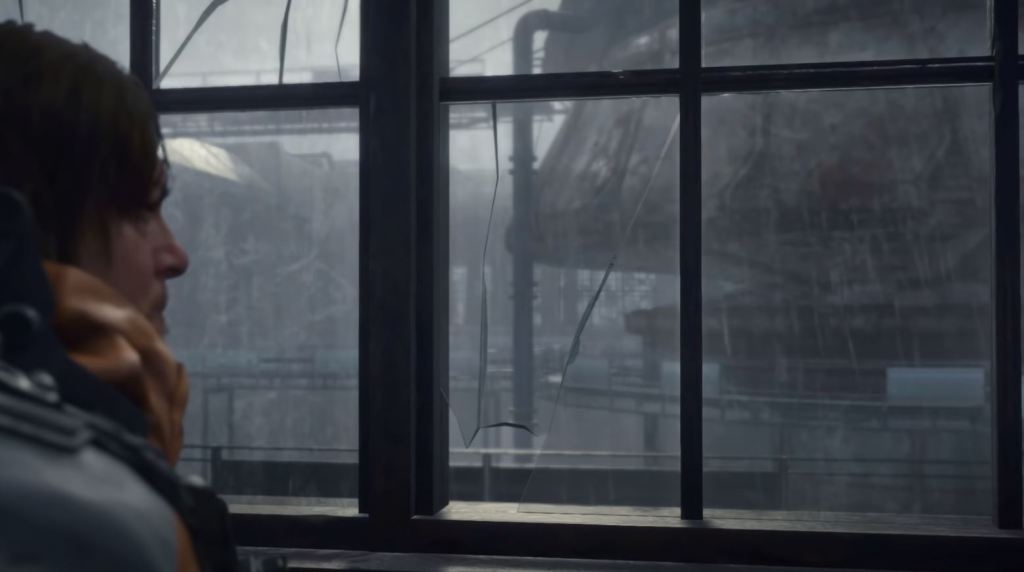
Picking up my colleague’s BB
As I travelled to the West Coast to finish what Amélie couldn’t, I felt the same sense of slow pace and reflection that I experienced on my long hikes, I loved the silence and the occasional Helloooo! from distant holograms. I felt a sense of gratitude toward my fellow delivery pals for the climbing anchor they planted and left behind. I myself started to pack a little more than I needed so that I could participate to the reconstruction effort. Drop some ceramics here to build a road, or lay the spare ladder there to make our return back home a little bit easier. Once in a while I would be reminded of my good deeds. The notification told me how many people used the ladder or the road and I felt rewarded. I got that sense of unity by working with invisible players towards the same goal.
But when I crossed the areas of Timefall (a form of acidic rain that ages everything it touches), I was reminded of something else. The tone shifted from exuberant carpets of moss to dry and toxic no man’s land imbued with eerie specters. Timefall and the tarry goo were like wounds left by the cataclysm that ravaged our Earth. I felt I was stepping into the exclusion zone of Chernobyl. Walking with my hood on amongst the granite rocks, and seeing the rust gnaw at the slick and shiny cases on my back, I felt contaminated and I remembered the bleak and brilliant adaptation of HBO and Sky. Chernobyl is born of human error, societal malfunction, us trying to bite more than we can chew and being reminded of the forces we play with. Was it the same with the voidouts? Did we break something in the land and the weather, break it to the point that it forced us into isolation? All I am told is that all this is the consequence of the Death Stranding but what is it? What caused it? There is a rich background underneath the surface that I hoped to gradually uncover as it was my role to try and reconnect the land and its inhabitants.
Reminding me of Chernobyl
As I progressed though, I learned nothing that helped me understand the catastrophe, instead we focused on a very archetypical villain Higgs, his actions and his threats. My taxing journeys through the land, feeling weary, invited questions of Nature and man-made chaos that vastly surpassed every threat Higgs was trying to make me care about. It made me ponder our societal dysfunction, transporting me from awe inspiring landscapes to nightmarish horror.
In a way, I felt my perseverance was tested the same way than when I was in the mountains and it was hard and I was tempted to turn back. The issue was, this is a game and turning back is very easy. It’s one button away. The temptation was great, especially when I reached a shelter and instead of feeling a sense of reward, I had to endure superficial, unnecessary dialogues which would answer none of my questions. I expected to learn about what happened more gradually, immerse myself into the intrigue at a pace that would fit that of my journey. Slow, but with a sense of progress, peaks and valleys. These islands of dialogues in the game between the initial 2 hours of cinematics and the encounter with Heartman in his massive alpine spa house frustrated and bored me. I felt I was not given anything to feed my curiosity, in the contrary the initial valuable information was being buried under secondary loosely connected stories. I had to power through cascades of tangled monologues from Die Hardman mixed with supposedly funny yet ineffective trash lines from random inhabitants. It felt like lines were thrown at me to keep me waiting, as if having dialogues in itself could carry me. They should have given me something interesting or kept it quite.
Eventually, Heartman tells me about the previous extinctions and there, he throws me a lifeline. I am with him again, I relate to the issue that I had merely forgotten and I feel what’s at stake. It hits very close to home, and I want to know what is that message that Kojima is wrapping in so many confusing layers of blather. I know now what he wants to question: our connection to others, the climate crisis, the horrors of war, our propensity to repeat the same mistakes over and over again, but what’s his resolution?
Heartman’s Alpine house
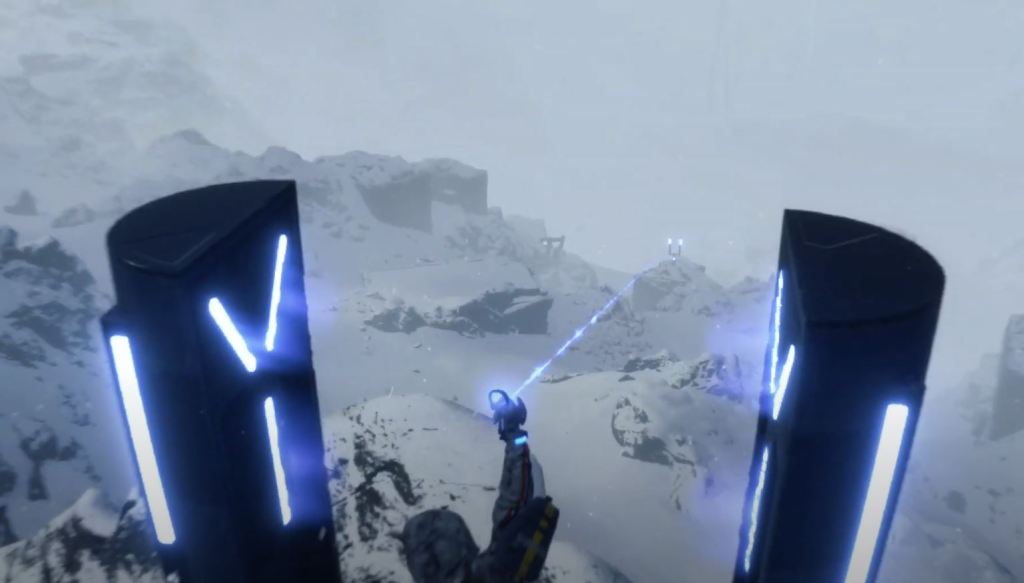
Not yet. I have to walk again through snow and craggy peaks. The survival aspect is more present now than ever in the cold. Even if I wanted to use fancy bikes now they wouldn’t carry me that far. I walk and I worry about my next step and the state of my shoes. I cannot fall, or I will never pick this up again. Thankfully my invisible partners in this venture have started to build a network of ziplines and I am eager to do my part so we can all eventually get there. I pack a bunch and move on.
Technology is our way to support each other. Working together in parallel planes, we build roads through jagged terrain and bridges over daunting rivers, but soon unused sturdy trucks start to spoil the environment, again. “Keep on keeping on” says a sign left there at the foot of the mountain to encourage me. How ironic is that? I too left a truck there to rot, and it felt terrible, like that loop of memories in which Cliff is trapped and in which BB pulls me. Is our unshakable resolve to carry on with our ways the greatest threat to our world and our very survival?
In the end, there is still so much that I don’t fully understand. It seems the lore created is so rich and throughout the game I have to learn its language Seam, DOOMS, Strands, Voidouts, Chirilium. Some of it contributes to the immersion in the futuristic world and its tech, but some of it remains confusing throughout.
At the end of the game, my main frustration remains the plot. The resolution felt shallow in the face of a catastrophe that felt so real. It did not live up to the expectations the core gameplay loop had me build over long hours of meditative walks, where I pondered the nature of death and our society’s excesses. When I thought I was starting to unfold the Death Stranding‘s mystery and the relationship between myself, my BB and its biological father, everything started to blur. I was shoved layers of convoluted details and the increased complexity of the story was the one route I was not given the tools to navigate. That intrigue I invested so much in, struggles to resolve itself and there is much left either unanswered or oversimplified.
However, looking back with the immediate frustration gone, I realize the plot did not matter that much. The narrative arc the team has carefully crafted does not add to the game message. At times it’s even distracting in comparison to the story the gameplay and the art are telling. The game remains an artistic, poignant, and jarring experience, strongly rooted in a political and social message. For the narrative part, you have to learn to let go. There is space for your own narrative in that world and that is what you should invest in.
The most powerful message I got from Death Stranding – and it still lingers at the back of my head – is that even when you’re gone, the consequences of your actions remain. It is our responsibility to think about what legacy we want to leave behind for the next generations and those who survive. The game teaches us about balance, it is our one constant preoccupation from start to finish. When that balance is tipped off, consequences have to be dealt with, crucial pieces of the world may be gone forever and while playing, you absolutely feel that. When the journey is so grueling it makes you care. When you hesitate and doubt so much to carry on, when your BB starts to cry through the controller because you fell, it makes you care. But you get back up, and you keep on keeping on.
Death Stranding is an experience of unity and perseverance. No matter how big the task, it gets accomplished one careful step at a time and every contribution matters. If we all walk in the same direction, if we support each other and pick up what someone else left off, then everything can be rebuilt.
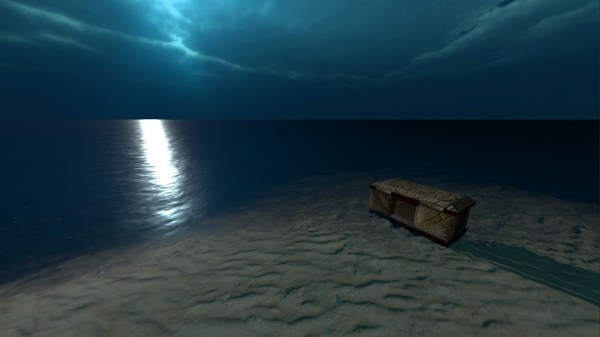
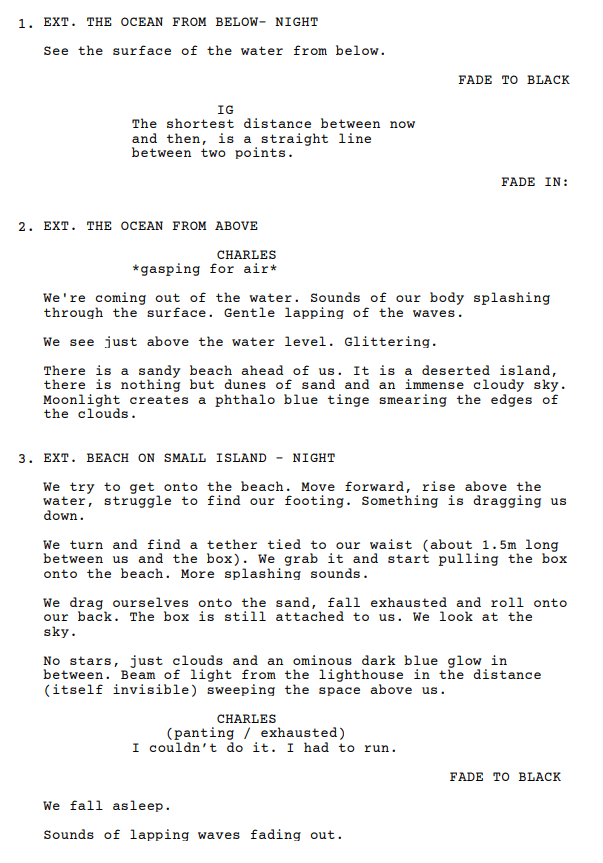
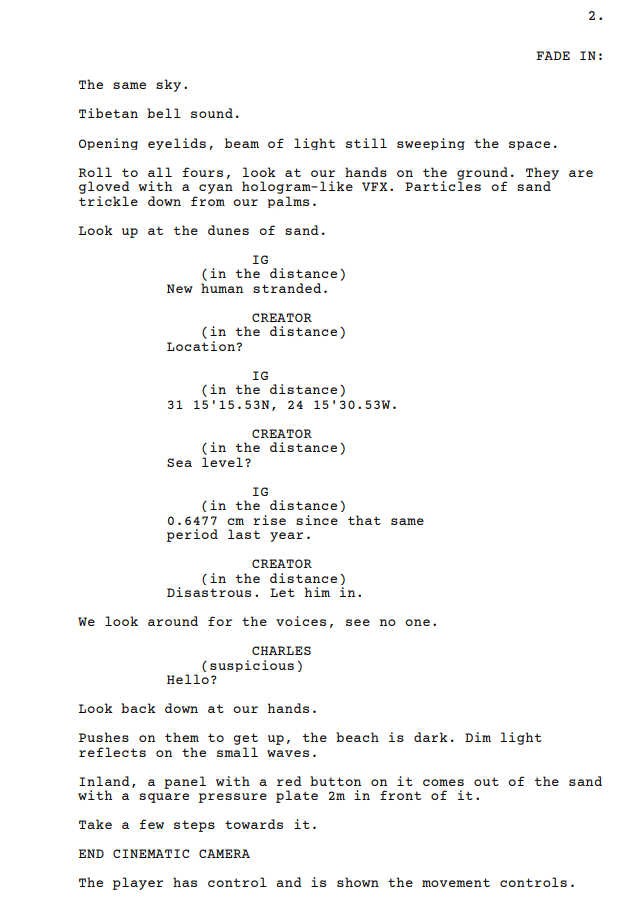
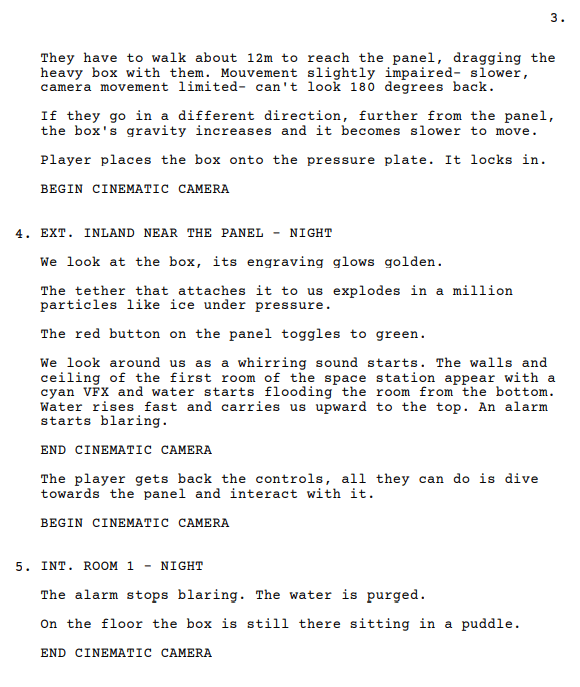
This is the script for the intro cinematic of Fractal Space on PC and consoles. The goal of this cinematic is two-fold: technically this is a mean for the developers to load a very small scene while loading the fist chapter in the background and making the gameflow seamless to the player creating the illusion that there is almost no loading time for the game.
The constraints coming from that are that the intro scene must be very light, few props, long enough to load the first chapter in the background, and not requiring much resources in terms of gameplay mechanics.
Narratively speaking, the goal is to establish a mystery that will hook the player as this intro will be made available in short demos. We want it to leave a strong impression on players, set the tone of the game and establish the first elements of lore and world building.
Script page 1Script page 2Script page 3
If you are looking for resources about cinematics:
I use a free software called KIT scenarist, it does everything you need, is very simple to use, and has no script number limitations. I like it.
On the question of when to put cinematics. My take is when you can’t put gameplay and want to limit the player experience to something very specific that you want to be the same for all your players. Ask yourselves and your game designers fellows, would the player want to PLAY that? It’s a game and the risk with cinematics is that players will want to skip them. Consider your target audience and weigh that in. Everything that can be played should be played, that’s why in the cinematic above you see interruptions for gameplay, everything that we could technically, reasonably allow the player to do, we wanted them to be able to do it.
Third tip: we writers love writing don’t we? People who work with us don’t need to love writing, they want this document so they can contribute their own skills and creativity and bring it to life. Be precise but don’t over-restrictive. Be concise, the steps must stand out, the layout of the scene must be clear. This is not the opportunity to showcase your prose, the shorter the better, but it should set a tone.
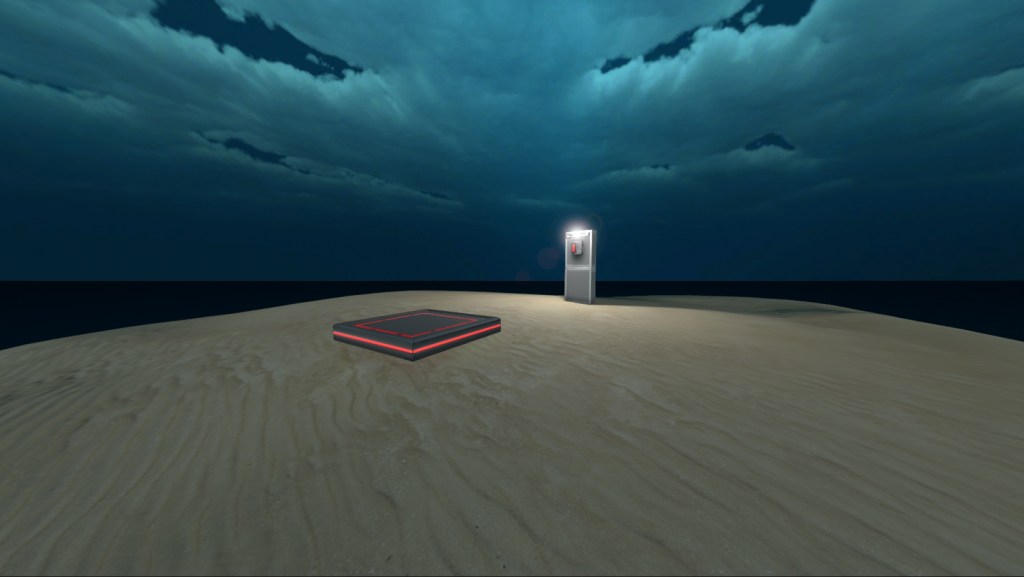
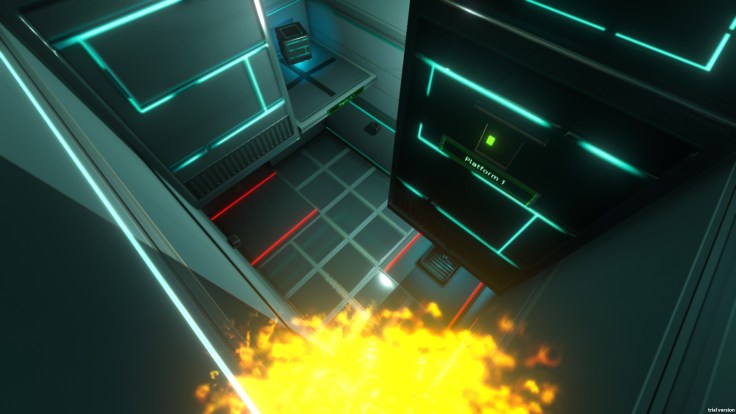
In this example, we want to load very little and the main users of this document are the game designer and the level designer hence the focus on layout and mechanics. In many cases, you will also want this document to go to your art team, so think about what they need to know. Here it is fairly simple: a beach, a box that is detailed in our lore so description is stripped down in the script, a heavy sky, a space station panel with a button and that’s IT. If your scene has more, make sure it is in your script, think about the light, weather, any important props. It will help you define the mood and atmosphere.
Adventure puzzle game, similar to What Remains of Edith Finch
Third Person, 2.5D
PLAYABLE CHARACTER
As part of Pixelles writing program, I created this character for a game concept.
Name: Stella Age: 13 odd human years which is much older in dog years and makes her a sage. Gender: Stella is a female dog. Race/Origin: Black dog, mixed race, looking like a chubby labrador. Important Visual: Stella is slightly cross eyed and she has a limp. With old age, she’s acquired white hairs on her chin. She always wears a collar but her owners change it depending on the occasion, her favourite is pink with bright yellow bananas on it. Affiliation/Team/Organization: A member of the family State: living and communicating in the first chapter, but then a ghost for the rest of the story.
Archetype/Inspiration Character[s]: – Mentor – Fairy godmother Enzo (The Art of Racing in the Rain — for his ability to understand humans’ way and cleverly work around them), Obi-Wan (Star Wars) Stella guides you, teaches you, except she’s a dog version of that noble man and wears a bandana in place of a cloak, Dug (in Up — it’s a plain character and loving, remember the quote: “I just met you, and I love you” Stella shares this extreme fondness).
3-4 keywords (personality traits): – Positive, – Cute, cute and awwww so cute, – Clumsy, – Will devour anything remotely edible (or just smelly)
Wants/Needs/Motivation: Stella reached the end of her journey and passed away. She is totally fine with that and she expects to live in her owners’ hearts forever, except, they are dealing with grief. Stella understands sorrow, and sadness, and grief too of course, but it is not supposed to last, and it seems that for humans it does last much longer than she wished. Their heart has thickened like leather and until it softens again, she can’t rest in there! She needs them to be normal again so she can stop roaming the world as a ghost. For her peaceful afterlife wish to come true, she has to accompany them through the various stages of grief as painful as this is. so their hearts can be soft and open to her again.
Other character relationships: Owner #1 is Henry. Initially he did not want a dog, he’s more of a cat person, but his partner very much wanted to get a dog so after several years he budged, and they adopted Stella. “She’s very big.” was his first thought, but she won him over and 2 months later they were napping on the sofa together and she took most of the space! Owner #2: Eyla is the one who adopted Stella. Initially she thought about adopting a puppy, but when they met, they both knew they belonged together. They go on walkies together and binge watch cooking competition shows.
Summary: The joyful companion
Voice Notes: Stella is an optimist, she does not use sarcasm. She is also very factual in her thinking. She has a problem and she does not worry about the outcome, she steadily works her way towards a solution. At the same time she is not cold at all, she is gentle and caring so her thoughts will always reflect these aspects of her personality.
Quotes: “If you rub my tummy, the world will seem a lot better you know.” “I would never leave you.”
Biography/Background: Stella’s initial journey in life was a tough one. She was adopted on a whim. A present for a girl she grew to love so much. But things went south. The girl left and quickly her owner lost interest in her. They spent days without going out of the apartment. She did her best to cheer him up, but the more she tried, the more it upset him. Once she spilled a bottle trying to get around the coffee table and the couch. Vodka did not taste good. Her owner was furious. One day, finally, they took the car and went for a walk. She was on her best behaviour. She was a good girl, she wanted to run in the forest and roll in the lush grass with him. But they did not. He did not take her back to the car either. She waited. For a while, she roamed in that same area. She learnt to hunt, and then she learnt about traps, not without damage. Later she perfected a better way: big smelly trash cans and how to topple them over. Now she had food, but no shelter. The first winter was cold, the second lonely. It felt very long until a lady caught her, put her in a truck and brought her to the shelter. Food: Check! Clean water: Check. Sleeping out of the rain: Check!! Life wasn’t bad. Someone would take her out twice a week, sometimes they even played fetch.
Until one day, a new lady came. There. With all her heart, she knew it. She was the one. But how to tell her? How to convince her? That night in her cramped kennel she could not sleep, but the lady felt it too and she came back and she never, ever left her.
Strengths: Wisdom, experience, very observant. Weaknesses: Cautious, she’s not the one to usually make decisions. Since she’s a ghost, she cannot be seen and she cannot express herself or interact directly with her owners. A lack of opposable thumbs…
Unique Look, Iconic Weaponry/Ability, or Core Gameplay: Stella has 1 special ability. She can infiltrate her owners’ dreams and feed them, push messages, or images, depending on what information she collected on that day.
Gameplay: During the day she has to find information by solving puzzles and she has to observe her owners and capture moments, things they say, images… At night she can rearrange them while they dream to build a response to how they feel and push it to them in their dreams. If she succeeds, on the next day their heart will be softer, if she fails, it’ll be harder.
Additional Info:
1- Her limp comes from a trap she got caught in during her weeks in the forest. She got out of it but she will never fully recover her mobility. 2- When she runs in her dreams, her owners think she’s chasing rabbits or playing with her dog friends. No she’s not! She’s running after a pizza delivery truck and someone throws her pizzas like they were frisbees! *heaven* 3- She lost a lot in her life, owners she loved, friends, babies. But Stella never stopped loving, not for long. She knows it is when you don’t love that the sun never shines again. 4- When you are a ghost, outside of your loved ones heart, you don’t sleep anymore. She misses sleeping, so sometimes she curls up against them and pretends to nap just to remember how good it felt. 5- Forget nature documentaries, dog videos with ducks or seagulls, cooking shows are the best!
This work was done in collaboration with game designer Robert Halvarsson.
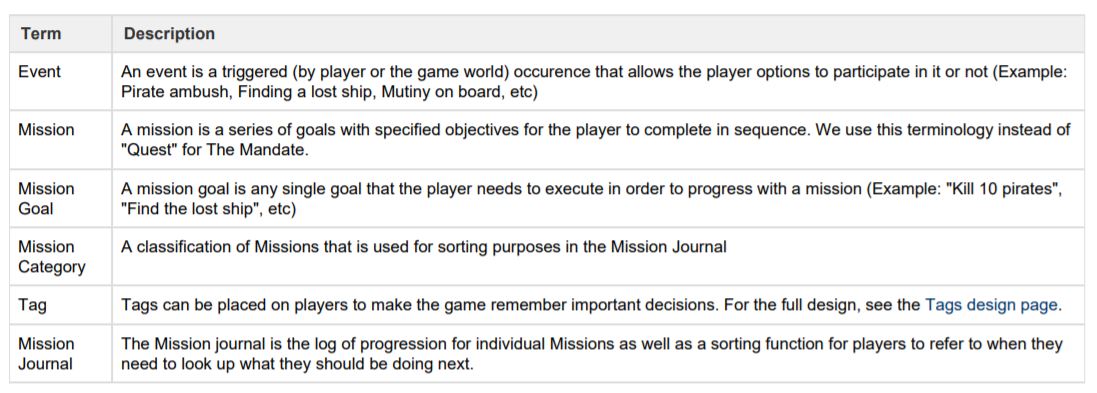
The goal was to define the narrative tools we would use to tell our story in The Mandate. I am not sharing the complete document but just an extract to illustrate what I mean when I discuss narrative tools and narrative design. This step is sometimes overlooked by teams and depending on the project’s complexity it might be fine because the design and the tools are very simple. The Mandate is an MMO RPG, defining the tools was a crucial step to the health of the project. It allowed us to shape the story around the means we had to tell it, and vice versa, because we had an idea of the kind of story we wanted, we defined 2 main categories of narrative tools: missions and events. This document also supports collaboration with Level Designers, Game Designers and Programmers, giving them a reference for when they create missions, events, triggers…
Design Goals The goal for this design is to: – Provide players with a Mission system that is as immersive as possible. – Provide meaningful player choices that affect the outcome of the Missions. – Utilize the gameplay elements we give the players as a method for players to reach their goals.
Terminology and Definitions
Summary Missions in The Mandate are more free-form objectives than step-by-step solutions. The player is not dragged by the nose through a series of objectives; rather – a mission is given out with a definite goal in mind and it is up to the player to decide how he or she employs the game systems in order to reach that objective. Missions are objectives that the player must complete in order to gain some sort of reward and the player knows in advance what the mission will get him so he has the feeling of working towards a reward.
Events are things that happen that the player may choose to partake in or not. Events may in turn spawn a mission for the player but it’s not the primary function of the event. Events do not have specified goals in them (although it’s possible to start a mission from an event to provide such goals), nor specified rewards, this adds randomness to the rewards from the player point of view.
Mission Example: The Arkwrights contact the player and ask him/her to destroy a specific starbase. Event Example: The Arkwrights ambush the player in an asteroid field because of the player’s low faction standing with the Arkwrights.
Events An event is a triggered (by player or the game world) occurrence that allows the player several options to participate in it or not (Example: Pirate ambush, Finding a lost ship, Mutiny on board, etc). Events are communicated to the player by the ship secondary in command officer to the player in a short briefing. Where the player gets to know what is going on, and for some events, the player may choose a plan of action (See design for Plan of action) on how to deal with the event. Example: The player comes across a ship dead in space. The briefing states “Captain, we’ve come across a ship dead in space. They are hailing us and are in need of repairs, what should we do?”. The options for the players could be “Ignore them”, “Help them out” or “Destroy the ship”.
Event Types Events in The Mandate are world or player-triggered occurrences that immerse the player in the world – events may be local to a planet, system, cluster or affect the entire world, depending on what type of event it is. Examples of event types (needs to be expanded upon) – Ambush – Distress Signal – Derelict Ship – Rescue Operation – Ship dead in space Each event employs a specific sequence of game actions depending on its Type. These game actions are what actually happens in the world.
Example: An event type could be called “Planetary Distress Signal”. This event type could be the parent for many different things, such as “Solar Storm” or “Lost Expedition” or “Evacuate the refugees” and so forth. Each of these individual events have a list of game actions attached, which affects the world. For instance – the “Lost Expedition” event may start a communicator chat signal with the player where a short briefing of the event is done, whereupon a mission is spawned on the player to save the lost expedition on a nearby planet. In our tool, an event consists of two parts – a Trigger with conditions attached and an Output.
Event Player choices Some events are mere text that will allow the player to choose what to do. An example would be a distress signal that is emitted from a planet, where the player can choose to either rescue the people, ignore the signal, or bomb the planet. Each choice has its own effects and consequences. Dialogue nodes that follow the first dialogue node are possible player choices. These nodes have the player choices available in the “Dialogue Text” field. The Script output field for these nodes are activated if the player chooses this option.
Event Triggers An event may only trigger if certain conditions are met. These conditions may range from the Player having a specific player standing, the existence of a nearby asteroid field or any stat check on the player or his ship. Triggers are set up with a specific chance and repeatability. The chance is a percentage change of the event actually triggering and the Repeatability is how many times the event can be repeated. If the repeatability of an event is set to “-1”, the event can trigger an infinite amount of times.
Mission Fundamentals Missions in The Mandate are different from Missions in many other games (MMO’s in particular) where a Mission is simply a small task such as a delivery, a targeted kill mission or similar. While we may have goals that are similar, the wrapping of Missions in The Mandate will not follow that pattern and instead allow players to forge their own path towards the goal of the Mission. Missions are: – A vehicle for telling the main story/drive the narrative – A way to obfuscate monotonous tasks / grinding via clever wrapping – Immerse and connect the player with the background lore – Push the player to explore new content (areas, factions etc) – Give the player clear direction which is especially important in a sandbox environment – Give ultimate goals rather than step by step details – allow the player to decide how to complete a goal by using existing game systems rather than leading the player.
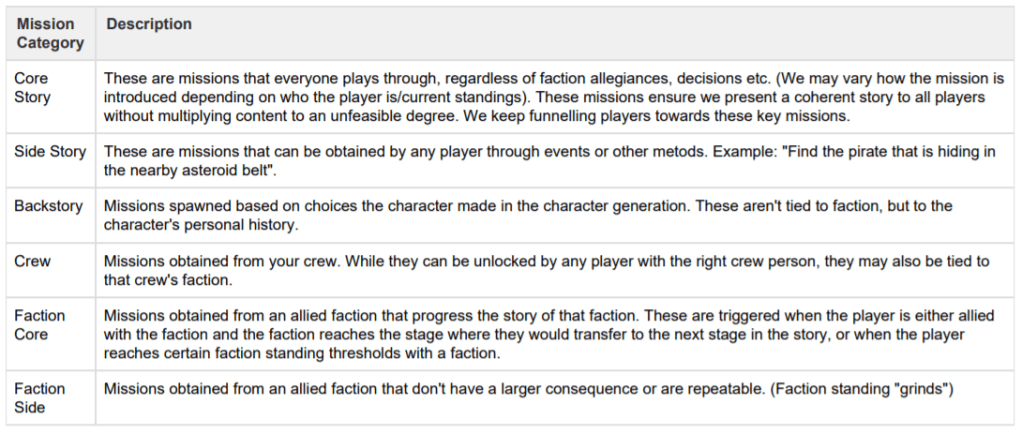
Mission Categories Mission Categories are used in the Mission Journal for sorting purposes.
I started working on Fractal Space about 5 years ago, for the mobile version of a game that was still in development but live at the same time. That was the big challenge, as the developer had released an early version and players were absolutely loving it, BUT there wasn’t really a plan for a story. The developer is leaning more towards C# than prose and he could sense that his game needed a story to infuse some life and a stronger identity into his game so he asked me to do it.
My first task was to understand what players already loved about the game and the universe, then look at the gameplay itself, what are we asking of the player? This allowed me to identify a theme and controlling idea that fitted this atmosphere he had already created. From there, I built a story that would accompany the player through Fractal Space maze of puzzles, provide break when the puzzles are hard, use joke to give him clues and add a layer of meaning to what the player was doing.
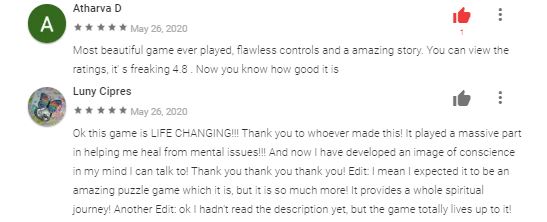
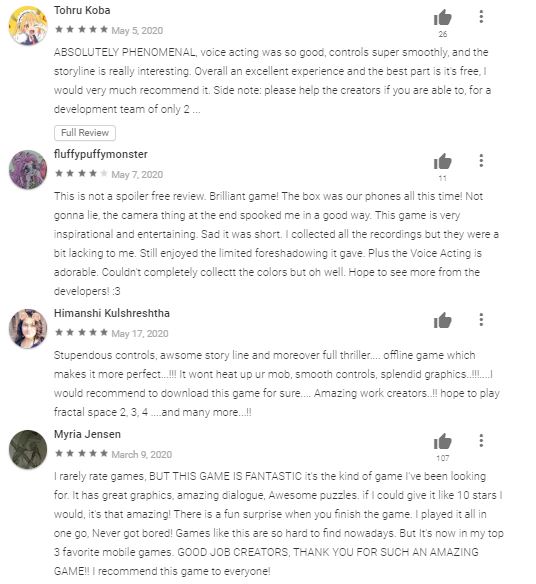
Today Fractal Space has 700k downloads on Android only and a 4.7 rating and many players love its original story which, while preserving its lighthearted tone, helps players reflect on the power of choice and the importance of balance in life.
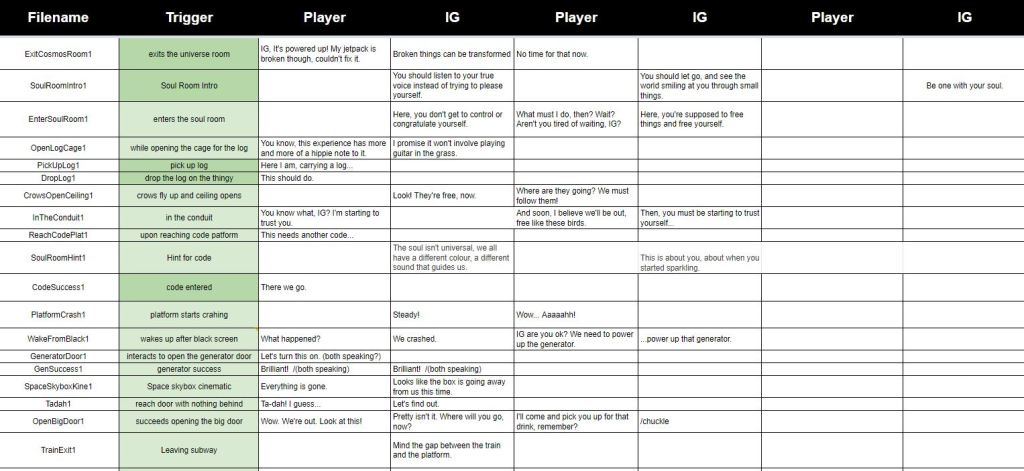
Example of a dialogue in chapter 4Another part of chapter 4
As you can see, the writing part is pretty low tech, what I need to have is a file name, a short description of how or when to trigger that dialogue and then the characters who speak. After that, once everyone has reviewed the lines and is happy, I integrated them in Unity. In this case using a custom system created by the devs themselves.
Each chapter of FS corresponds to a major plot point and has an associated theme that strongly binds the art, the level design and the story together. Our goal is to tell a story without drowning the players in words, to do that we use the level design and the activity or actions we request of the player as a story telling tool. For example, there is a chapter about loops and patterns, the idea here is to discuss how we tend to repeat similar patterns in our life and how that blinds us and blocks our progression. In this chapter, the player goes through a series of rooms that have the exact same shape, but to solve them, he needs to break the previous pattern every time. For the last one, he needs to run in a straight line, move forward, which echoes the very first line of the game and our key message “The shortest distance between now and then is a straight line between two points.”
In FS, level design and stories are tightly knit together and it is their combination that allows us to tell a powerful story of escape, choices and growth.
Time to let the players speak:
5 years after the mobile version, I’m working on a new version of the same story for the PC and console edition of the game, with plenty of new rooms and new player tools. To be continued…
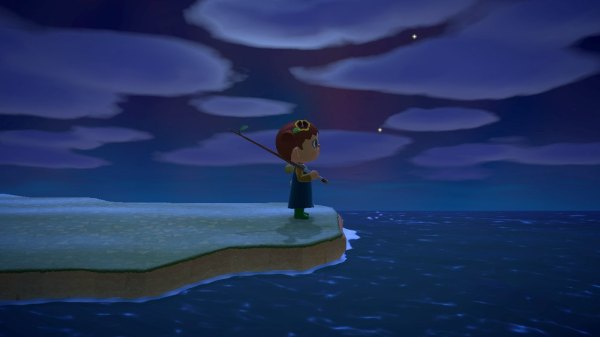
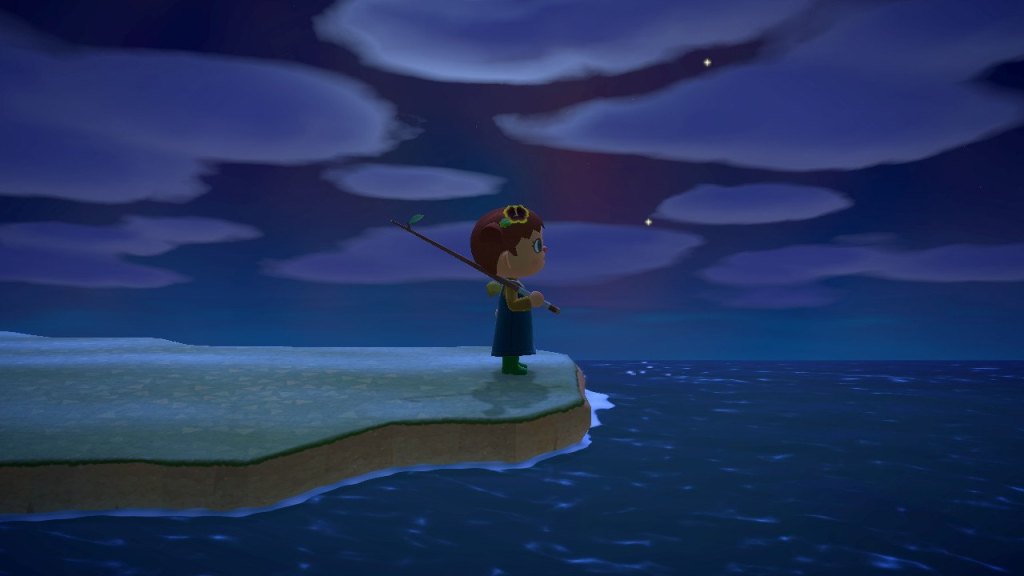
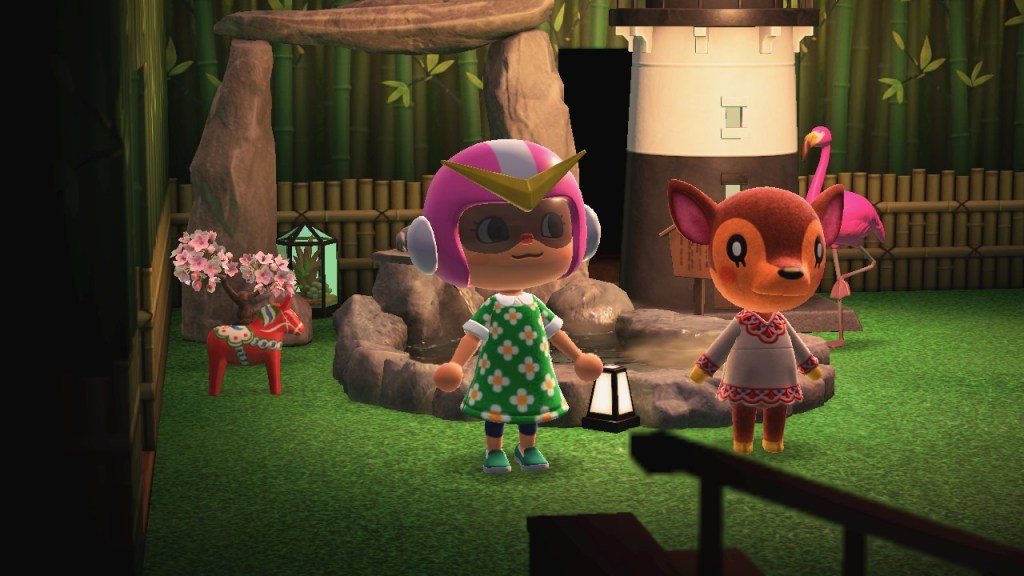
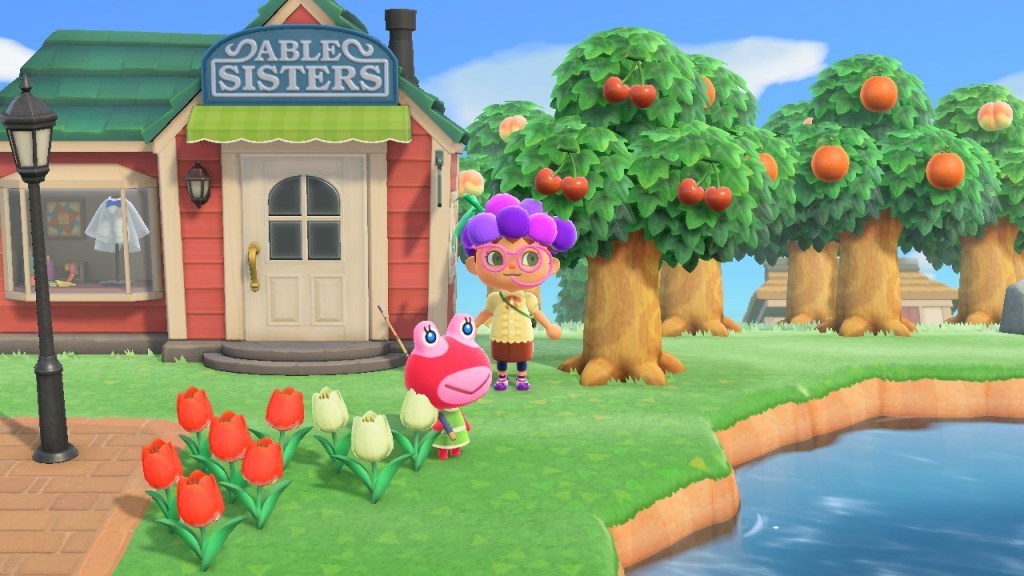
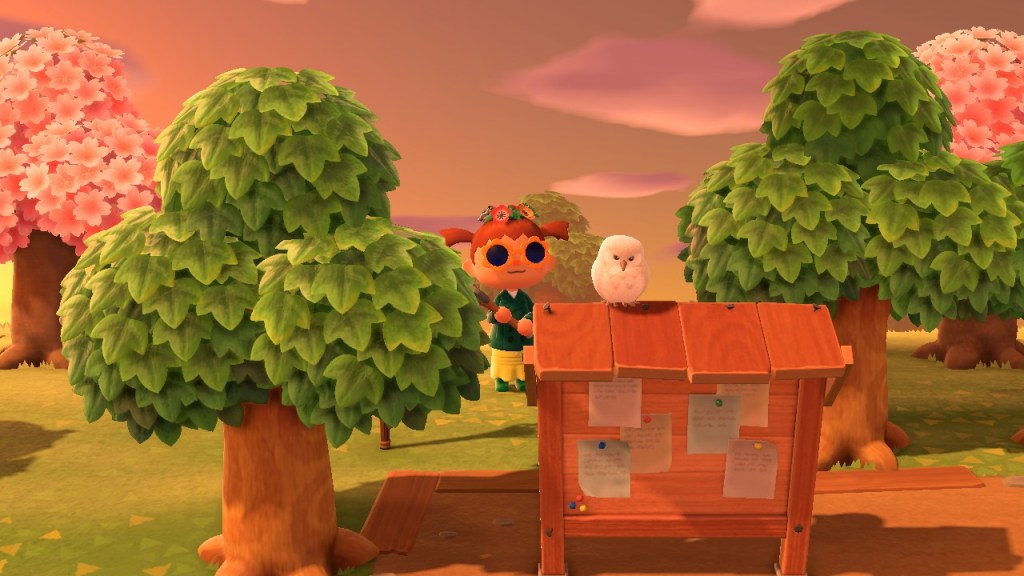
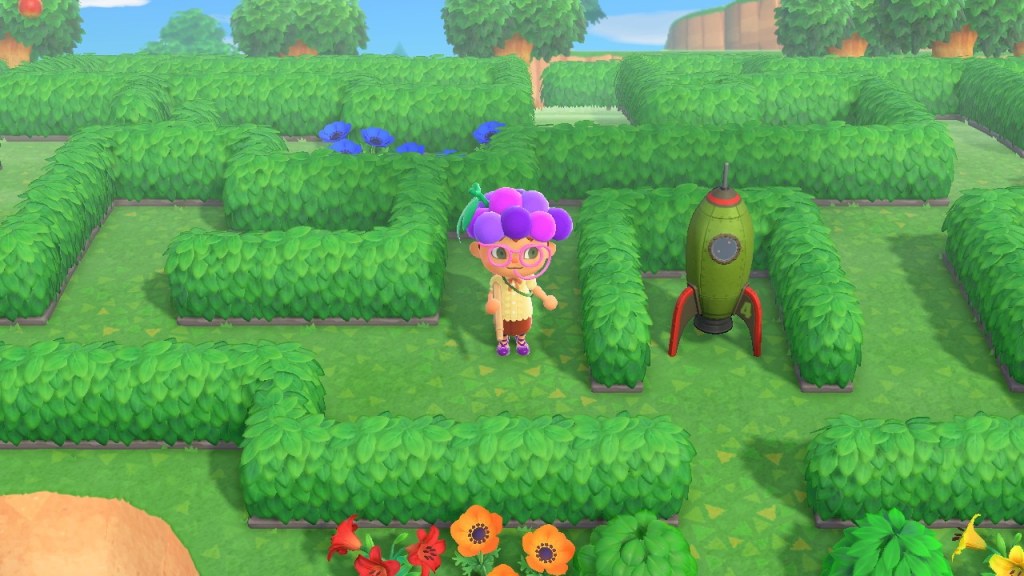
A deserted island, the cutest villagers one could hope for and coconut trees that look like plastic toys from your niece’s dolls beach party set: welcome to Animal Crossing: New Horizons!
New Horizons, the latest edition of the beloved franchise features friendship, love, and gratefulness to be together on a wonderful island as its main theme, and it is Nintendo’s latest hit. Creating your own adventure on this island where you’re in control and NPC villagers look up to you, where you can live a happy free life shaking trees and picking up sea shells, has attracted more players at launch than any Mario or Zelda in history. It provides millions of players with a bubble where to retreat and forget about the growing numbers of infected people our real world is struggling with. It is also a germ-free space where to continue to meet and be kind to our real friends by sharing spare DIYs, or sending space rockets through the mail and help your friend complete an island that will perfectly represent who they are.
On top of that ACNH is one of these rare games that reinforces players positive behaviour taking a different, progressive stance on toxicity issues. ACNH is not focusing on just preventing player’s toxic behaviour, here players are rewarded for being nice to each other, for inviting each other to visit and for sending lovely gifts. In this game you can’t steal someone’s furniture, but the guest can pick it up and drop for you so you can take it with you when you leave. This is helping players’ communities bloom, be it to make your friends benefit from the best turnip price or to trade a tier 1 villager. People become nice as habit and will leave tips and prezzies after visiting as a gesture to thank their turnip seller host.
But sadly it’s not just about friendship, something else at the core of the players progression ties the game into a consistent player experience and that’s Bells. So how do you progress in Animal Crossing?
Well for me, that’s the sad part, you progress through a very cute debt system where Bells are your holy grail.
Remember the very start of the game? You are purchasing a vacation package, deciding to isolate on a deserted island and get a true experience of the wild. After that the game starts and your goal is to make the island prettier and more hospitable for yourself and the thriving community of NPCs that will gradually appear. To achieve that, the first step (and there is no avoiding it) it to take up a huge loan from Tom Nook (read Tanuki Mega Lord). From then on, your main motivation is to pay back this initial debt, then take on a new one to improve either your house or the island infrastructure, and so on and so forth.
As in John Locke‘s vision, everything that nature provides and that is not the private property of another person is yours to claim. Everything that you can collect on the island is yours to sell and help pay back Nook services. You collect bugs and fruits and pick up the “weeds” as they are not desirable, not even permitted, if you want to achieve one day the island top star rating. So what players do is basically appropriate and “rearrange” that nature and wilderness they came in to seek, to replace it with paved streets and snack machines, all purchased with the Bells acquired selling nature’s goods. In Animal Crossing there is only one way forward and that’s Capitalism.
The game teaches you to borrow money and to work to pay it back, the island evaluation system will reward islands where the player has build fences and infrastructures, where villagers’ delimited gardens are stuffed with cute BBQ and retro dinners chairs. Pastoralism, minimalism or ecology goes against your progression. In New Horizons, like in our modern world, social status is acquired through the accumulation of goods. Of course, purchased furniture will grant you more points than DIY and the most expensive the better! For those who miss the thrill of the stock exchange, there is even Daisy Mae who grants you access to the Stalk exchange where you bid on the price of turnips driving players to build additional rooms only to store the most pricey root vegetable there is and get a chance to become a multi millionaire. There is even a loyalty program called Nook Miles, where the more you spend the more you are given points you can then use to buy say, travel tickets to other deserted islands and scavenge all their fruits and minerals to make more Bells.
Thanks to these features, no one can say there is nothing to do anymore because there is always a way to earn Miles with the never ending daily challenges. Wasn’t it a nice message though to have nothing to do on this little island? Shouldn’t we encourage players to do more of nothing and be creative on their own and contemplate the little things rather than act according to what will bring them Bells or Miles?
At one point players can even terraform their land, you no longer just do the best with what you’re given but now you’re so mighty you can completely alter it to your will without much second thoughts.
Despite this Lockean idea, ACNH tries to instill in its players a notion that respecting and supporting nature is important (again it’ll reward you in Nook Miles). On Earth week for example, it encouraged players to plant fruit trees and seed flowers. The problem is that the 2 hardly coexist as the reward is always in the form of a currency. In the same week players were rewarded for weeding and cutting trees just as much as they were for planting them, and their motivation in both scenarios is to earn Miles, not do what’s respectful of the environment or to see something cool that would come from nature, the island or Earth. There is no penalty for leaving trash on the beach, and players are encouraged to colonize their whole island and leave nothing untouched, because if you don’t, well nothing new or exciting really happens, you don’t attract villagers or visitors and the untouched area doesn’t evolve or reward you like the altered area does.
Why not use this opportunity to truly inform players and reward positive respectful behaviour that they will then transfer to their daily habits? The game feels to me like a missed opportunity to inform and reflect on our society and its priorities in a fun way. Why not encourage players to leave a space of their deserted island truly untouched and see what magic could happen there? Why do we have to act on this deserted island as if we owned it all like most people do already in real life and has lead us to the catastrophic state in which our planet is in?
I wish the game did not just pretend to care about the ecology but provided an opportunity to illustrate a cohabitation between the nature and the human-built world. I wish the game would hint at the rewards of working with nature and get inspiration from it rather than encourage us to keep building and accumulating more and more. Isn’t it time yet for games to suggest an alternative to our money and status seeking societies? The very controversial game Mountain, back in 2014 excited and fascinated us writers with its ambient melancholic internal dialogue. It encouraged its players, or passive witnesses of the seasons to feel for this mountain where cars and garbage come and crash down from nowhere. A game as successful as New Horizons, played by millions of players both young and fully developed adults, presents such a huge potential to touch players and ask today’s central question of the impact and responsibility of our life styles on the state of our home, our once upon a time deserted island.
Animal Crossing first appears as the cute getaway from daily life only to play by the same old rules. It reinforces the standards and values that have lead us to behave as if we didn’t have to share our planet with other species. It is a relaxing escape in this time of pandemic but only if you don’t think too much of what its reward system subconsciously trains us to consider progress.
Ceres leader, starts as our hero’s ally and will eventually be the one to betray him. Protects and funds Dust’s research in the Belt, organizes the belt military effort.
Region
Ceres / the Belt
Quote
Belters stand united!
Archetype: The creator
Strengths: Natural leader, charismatic, sense of justice, willpower, efficient.
Weaknesses: Lack of recognition, greed for power. Narrow-minded, prevents him from seeing the whole picture, weak body.
Characterisation
Adisa is the first generation of people born in the Belt, from hippie parents who themselves were born on Mercury and fled to Europa when it offered the first settlements, they left behind the caste system and married. His parents were intelligent and kind, they were also full of hope and thought they could seek a life away from the ruses of politics. They believed that inner and outer governments were alike, they didn’t care for the welfare of the common folks and since they didn’t care, they wouldn’t chase those who decided to leave the system behind.
They left with their first daughter and joined a community that preached natural evolution in the Isimud cluster. They studied how to help the body adapt to their new life conditions and conducted several experiments, on themselves and their children in the name of Science.
They learned to move in low gravity, to deal with low pressure, and gradually to get rid of their implants. They lived in small shared habitats, they raised the community children all together as if they were their own and Adisa’s mother was one of the first to bear a child in those conditions, a child that lived. They called him Adisa, the lucid one, hoping he would see through the schemes of power and defend the good.
Adisa was lucid, and as he grew, he understood his parents’ community was an ideal but no one would care, because they were powerless and they all died young. He left Isimud with his own precept “Be good, but don’t be a fool.”
Description
Friendly,
Sick,
Devoted to his cause.
His body is weak, elongated with thin bones, his heart is weak, he has to use various cybernetics to remain relatively healthy.
His ethnicity is multiracial like most outers, showing both African (through his short dense curly hair) and Arab. His back is tattooed with a Japanese koi.
He believes he is the dark side that can protect the pure souls that have found shelter in the Belt, in his belt. He sees himself as factual, reasonable and a necessary evil.
Real nature
In his heart he rages for all the injustices the government maintains in place, he wants to bring them down, he wants revenge for all the suffering more than he wants to bring peace, but he knows that’s not acceptable. He has been raised as a member of a peaceful community and he knows what his heart seeks is wrong. He fights an inside battle to contain his thirst for power and desire for war, a rightful war, until the time has come. Before the belt can fight, the belt needs to acknowledge it is a united nation with rights, a nation that abolishes differences and that considers everyone equal. His ambition doesn’t stop at defending the Belt, he wants the Belt to lead the future of humanity.
To impose himself as a leader he will use brute force and build a massive weapon. He has investigated an old legend from the Belt and found it held truth and clues to an older civilization and the schematics to a powerful weapon.
People will die but they will die martyrs, and he will emerge as the hero that united and elevated the status of all the colonies of the Belt.
More on character design:
I like this one because it was with this character that my mentor taught me about balance. One thing that we writers fear the most is to fall into tropes and stereotypes, so we need tools to help us keep our characters in check and make sure we can bring them depth and details without creating a caricature.
Using archetypes is a necessity for efficiency. There is so much we know and share from our common experience of stories, archetypes create a immediate sense of familiarity, they make it easy for us to relate to them and understand their motivations without having to dive into long explanations of their background that would justify why they feel and act so. I personally like to use the 12 Jungian Archetypes, I guess that’s easily explained by my background in psychology… but you can find endless lists of archetypes online so browse and get inspired.
Be mindful though when writing characters and working with archetypes as some stereotypes can be hurtful and it our responsibility as writers not to reproduce that. First always do your research, second never hesitate to check for authenticity with folks from that community. Get their sense on what might have biased you in describing a character from an under represented group in such a way, they’ll tell you and you will grow, maybe you did not make any mistakes then but talking to the relevant people you will have learned to avoid mistakes in the future. I can’t emphasize this enough, write diverse characters, BUT you cannot possibly think of every question, so research and speak to the right folks about it.
In order to balance out my characters I like to use strengths and weaknesses, they are very short, very easy to share in the character’s summary for the rest of the team and they will give you a good sense of the character depth. If your character, doesn’t have weaknesses, you probably want to get back to the thinking board.
The other thing that my mentor taught me is to split the bio part into 2 parts, especially for the type of game we were working on. He called these 2 parts: Characterization and Real nature. This is intended to give you a sense of your character arc and evolution over time. Where do you come from: characterization, where is that character going: real nature. That aspect of their personality will reveal through the character’s actions in the set of obstacles that you are laying down for them in your game.
The chronology is an important aspect of the lore that helps the writing team both get inspiration for writing missions, and maintain an overarching consistency in the universe we develop.
3.5 million years ago
TLDR:
Humans lived under the protection of an Alien race
Humans betrayed Aliens and stole a secret knowledge and tech
Humans turned this knowledge into a massive weapon and destryoed a planet
Some of the humans survived and fled
We have lost the knowledge of what happened then and of how humanity developed after.
Humans came to Phaeton from Earth. The fifth planet was inhabited by an intelligent pacifist species who had achieved high technological development. For several thousands of years, they lived a peaceful life. These aliens had a tool they used for travelling, they shared only part of this tool’s secrets with what resembled a human race who had recently discovered their planet and it allowed them to travel faster as well as use long distance instantaneous communication. However, they refused to share the technology allowing instantaneous travel, fearing they would misuse it. Years passed, and the humans grew jealous of the aliens’ knowledge. They started resenting the fact they held knowledge from them so they stole their secret.
They needed a Navigator. Navigators are people born prescient enough to access another dimension and guide the ships to the right location. To upgrade the structure of their port and be able to teleport objects, the humans needed Navigators but it seemed only aliens had this skill. They kidnapped alien children, studied them until they managed to create a serum that allowed them to modify human children so that they would adopt alien characteristics. The aliens eventually realized humanity’s betrayal and grieved their generosity along with a consequence they can foresee but not stop.
As they had anticipated, humans built a canon allowing them to teleport void and create super massive implosions. They destroyed the fifth planet and murdered the race that had been their host for the last millennia.
Today, no one knows if some aliens managed to escape, we only know humans did, leaving their slaves and prisoners behind in the midst of the chaos they created. Planets’ orbits changed, moons fell, meteorites crisscrossed the sky for thousands of years. After their tragic mistake, humans struggled to flee the solar system. The abandoned ones, the low caste that stayed behind flew to Earth. Many died in their ships crushed on the unpredictable trajectory of various stellar objects. Those who reached Earth dug underground cities and lived there waiting for the sky to stop falling.
800 years ago
TLDR:
3 terraformed planets: Earth, Mars and Luna
All scrambling for resources and stations are overpopulated
Political tensions are brewing
Population has reached its maximum on all 3 terraformed planets. Mercury settlement is still not complete and more people than it can host are waiting on orbiting stations. Only Mars has regulated its population and its resource consumption drastically, but Earth which used to be the most hospitable planet now requires oxygen from Europa to be pumped into its atmosphere. Earth has overshot its population growth target and its resources consumption target alienating Mars against them as Martians are forced to take on more and more refugees.
Luna terraformation is underway but in Mars’ opinion it’s costing the system more than the benefits it will offer. A magnetic line, the lift, is drawn from Luna to Earth in order to guide shuttles for sending colonies outer space. Governments agree that the outer solar system is the future and it needs to be conquered to solve this issue. Mars is taking the lead and outer exploration is voted a priority against Venus terraformation, energy corporations are securing government funds to be able to send ships to Jupiter’s moon within 50 years. More and more people are accumulated on generation ships while waiting for a hospitable planet, there is a new generation of people that has never set foot on a planet in their entire life.
700 years ago
TLDR:
Technological advance allows to explore beyond the belt
Resources of the outer world appease a little bit the political tensions between the planets’ governments
Human race achieves faster propulsion making possible the exploration of planets beyond the asteroid belt. We start by sending penal colonies leaving from Mars to Europa and Callisto providing the initial workforce for the Outer Mining Stations OMS. Europa’s goal is to sustain the water needs of the inner planets. Earth is on the verge of collapsing and has stopped supplying Mars which terraformation has taken 200 years longer than expected and which weather is still not regulated to support the water needs of its colonies. The last resources are used to send generation ships beyond the asteroid belt and the first long range ice haulers. The success of the Europa probe ship eased the tensions between Earth and Mars and successful negotiations lead to the first settlement a year after with regular shuttle supplying both planets in water. The resources in the outer world were more than the governments had expected, more probe ships were sent and returned with promising results.
[…]
25 years ago
The outer government has evolved into an oligarchy. A totalitarian regime takes over the inner planets and decides to start mining the Belt for resources they can’t obtain otherwise. An Earther preservation project that scientists have long been working on launches the Arch, the first massive space animal station where 7 animals of every remaining species on Earth embark.
8 years ago
Our player was fighting for the Inner Alliance to protect Deimos and its neighboring stations when it is blown away and his fleet is sacrificed by missiles sent from Mars. The player refuses to die for a government that betrayed him and he flees to the Belt saving the civilians he can bring onboard. One of them is Norma Vacen, an engineer from Khors and her team. The player finds a new home in Pallas, fixes and repaints his ship. Branded a traitor, his crew becomes his family and they can never go home. He finds work in the Belt more easily than he would have thought, legal or almost legal contracts, escorts, deliveries, protection missions. Life is not bad. One organisation has tried to recruit him, Ceres Republik, their propaganda is intensifying, they have started building stronger defenses to protect the Belt, mostly from abusive mining from the Inners They’re always looking for good soldiers and good pilots. But even if they are an anarchic organisation, they’re just another organisation. The player takes contracts from them but he is not pledging allegiance to their group. What did he learn? Live for yourself and for your people, never trust a government to make the right decision, the people are just gun holders to them.
Present time: year 3479
Kaden Doran is taking various contracts to transport resources around the Belt and safely escort civilians. He has no affiliation beyond money.





 Amélie Beaudroit