
This work was done in collaboration with game designer Robert Halvarsson.
The goal was to define the narrative tools we would use to tell our story in The Mandate. I am not sharing the complete document but just an extract to illustrate what I mean when I discuss narrative tools and narrative design. This step is sometimes overlooked by teams and depending on the project’s complexity it might be fine because the design and the tools are very simple. The Mandate is an MMO RPG, defining the tools was a crucial step to the health of the project. It allowed us to shape the story around the means we had to tell it, and vice versa, because we had an idea of the kind of story we wanted, we defined 2 main categories of narrative tools: missions and events. This document also supports collaboration with Level Designers, Game Designers and Programmers, giving them a reference for when they create missions, events, triggers…
Design Goals
The goal for this design is to:
– Provide players with a Mission system that is as immersive as possible.
– Provide meaningful player choices that affect the outcome of the Missions.
– Utilize the gameplay elements we give the players as a method for players to reach their goals.
Terminology and Definitions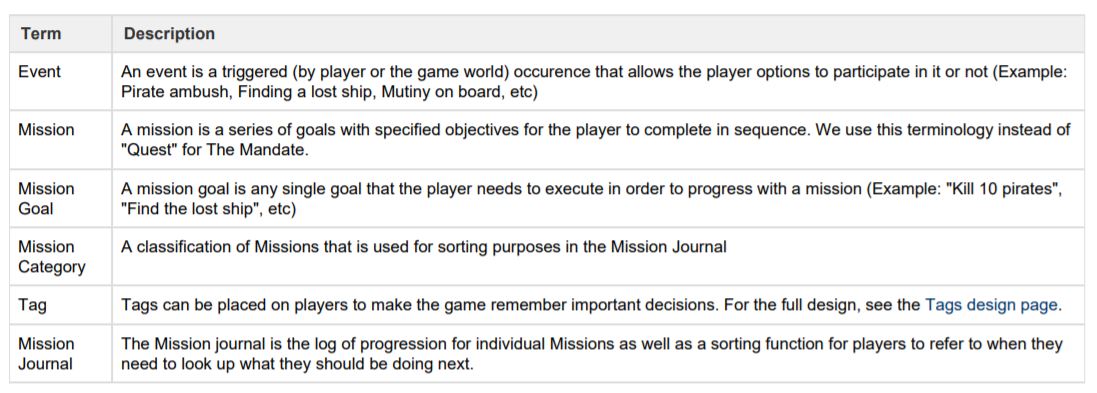
Summary
Missions in The Mandate are more free-form objectives than step-by-step solutions. The player is not dragged by the nose through a series of objectives; rather – a mission is given out with a definite goal in mind and it is up to the player to decide how he or she employs the game systems in order to reach that objective. Missions are objectives that the player must complete in order to gain some sort of reward and the player knows in advance what the mission will get him so he has the feeling of working towards a reward.
Events are things that happen that the player may choose to partake in or not. Events may in turn spawn a mission for the player but it’s not the primary function of the event.
Events do not have specified goals in them (although it’s possible to start a mission from an event to provide such goals), nor specified rewards, this adds randomness to the rewards from the player point of view.
Mission Example: The Arkwrights contact the player and ask him/her to destroy a specific starbase.
Event Example: The Arkwrights ambush the player in an asteroid field because of the player’s low faction standing with the Arkwrights.
Events
An event is a triggered (by player or the game world) occurrence that allows the player several options to participate in it or not (Example: Pirate ambush, Finding a lost ship, Mutiny on board, etc). Events are communicated to the player by the ship secondary in command officer to the player in a short briefing. Where the player gets to know what is going on, and for some events, the player may choose a plan of action (See design for Plan of action) on how to deal with the event.
Example:
The player comes across a ship dead in space. The briefing states “Captain, we’ve come across a ship dead in space. They are hailing us and are in need of repairs, what should we do?”. The options for the players could be “Ignore them”, “Help them out” or “Destroy the ship”.
Event Types
Events in The Mandate are world or player-triggered occurrences that immerse the player in the world – events may be local to a planet, system, cluster or affect the entire world, depending on what type of event it is.
Examples of event types (needs to be expanded upon)
– Ambush
– Distress Signal
– Derelict Ship
– Rescue Operation
– Ship dead in space
Each event employs a specific sequence of game actions depending on its Type. These game actions are what actually happens in the world.
Example:
An event type could be called “Planetary Distress Signal”. This event type could be the parent for many different things, such as “Solar Storm” or “Lost Expedition” or “Evacuate the refugees” and so forth. Each of these individual events have a list of game actions attached, which affects the world. For instance – the “Lost Expedition” event may start a communicator chat signal with the player where a short briefing of the event is done, whereupon a mission is spawned on the player to save the lost expedition on a nearby planet.
In our tool, an event consists of two parts – a Trigger with conditions attached and an Output.
Event Player choices
Some events are mere text that will allow the player to choose what to do. An example would be a distress signal that is emitted from a planet, where the player can choose to either rescue the people, ignore the signal, or bomb the planet. Each choice has its own effects and consequences.
Dialogue nodes that follow the first dialogue node are possible player choices. These nodes have the player choices available in the “Dialogue Text” field. The Script output field for these nodes are activated if the player chooses this option.
Event Triggers
An event may only trigger if certain conditions are met. These conditions may range from the Player having a specific player standing, the existence of a nearby asteroid field or any stat check on the player or his ship. Triggers are set up with a specific chance and repeatability.
The chance is a percentage change of the event actually triggering and the Repeatability is how many times the event can be repeated. If the repeatability of an event is set to “-1”, the event can trigger an infinite amount of times.
Mission Fundamentals
Missions in The Mandate are different from Missions in many other games (MMO’s in particular) where a Mission is simply a small task such as a delivery, a targeted kill mission or similar. While we may have goals that are similar, the wrapping of Missions in The Mandate will not follow that pattern and instead allow players to forge their own path towards the goal of the Mission.
Missions are:
– A vehicle for telling the main story/drive the narrative
– A way to obfuscate monotonous tasks / grinding via clever wrapping
– Immerse and connect the player with the background lore
– Push the player to explore new content (areas, factions etc)
– Give the player clear direction which is especially important in a sandbox environment
– Give ultimate goals rather than step by step details – allow the player to decide how to complete a goal by using existing game systems rather than leading the player.
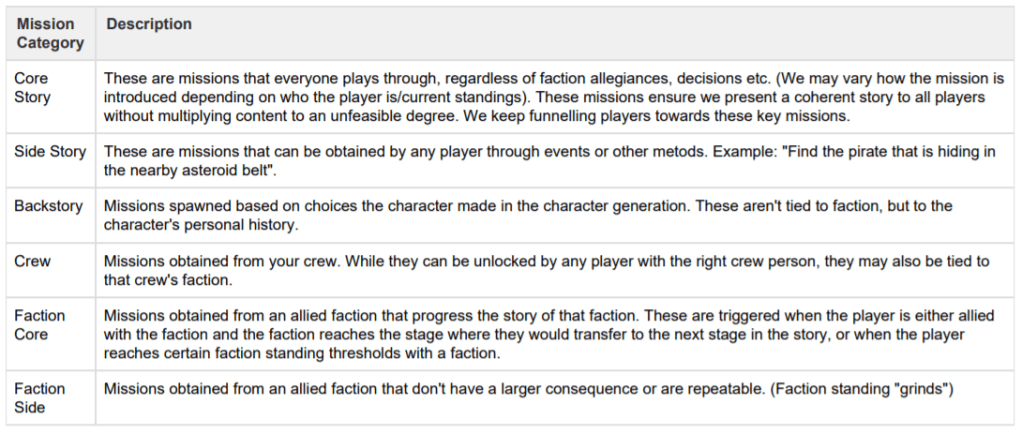
Mission Categories
Mission Categories are used in the Mission Journal for sorting purposes.
 Amélie Beaudroit
Leave a comment