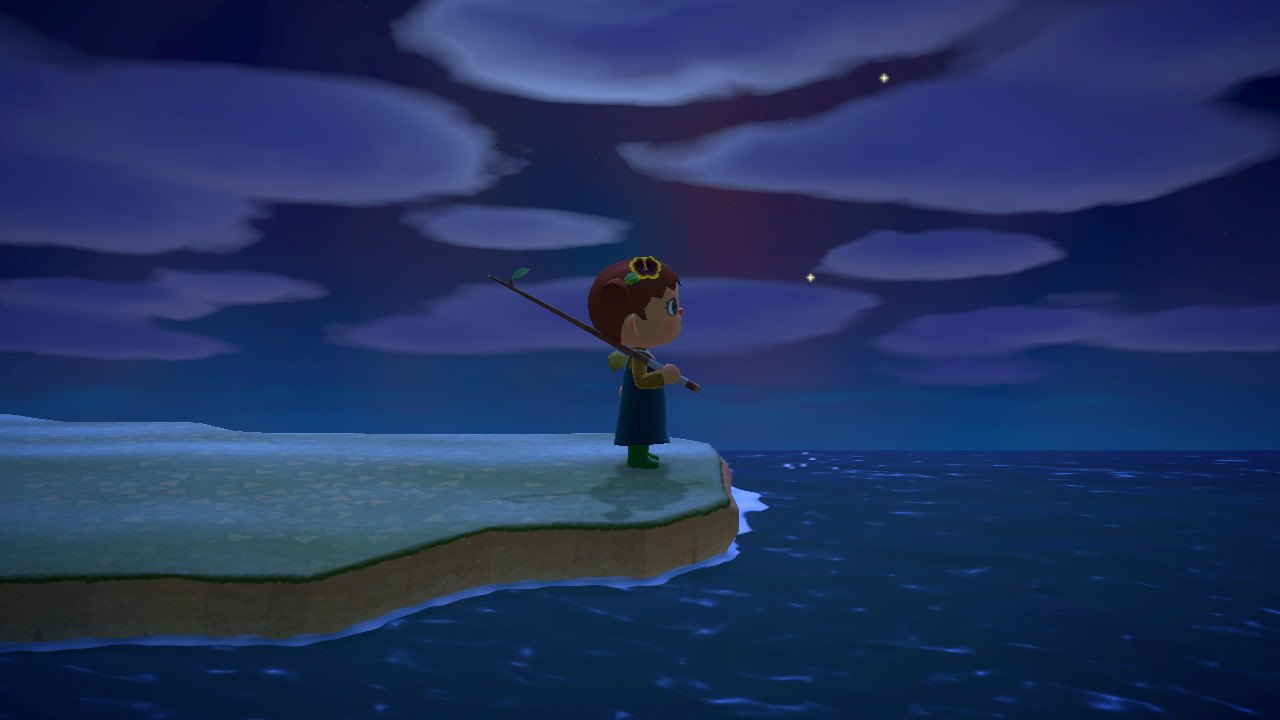
A deserted island, the cutest villagers one could hope for and coconut trees that look like plastic toys from your niece’s dolls beach party set: welcome to Animal Crossing: New Horizons!
New Horizons, the latest edition of the beloved franchise features friendship, love, and gratefulness to be together on a wonderful island as its main theme, and it is Nintendo’s latest hit. Creating your own adventure on this island where you’re in control and NPC villagers look up to you, where you can live a happy free life shaking trees and picking up sea shells, has attracted more players at launch than any Mario or Zelda in history. It provides millions of players with a bubble where to retreat and forget about the growing numbers of infected people our real world is struggling with. It is also a germ-free space where to continue to meet and be kind to our real friends by sharing spare DIYs, or sending space rockets through the mail and help your friend complete an island that will perfectly represent who they are.
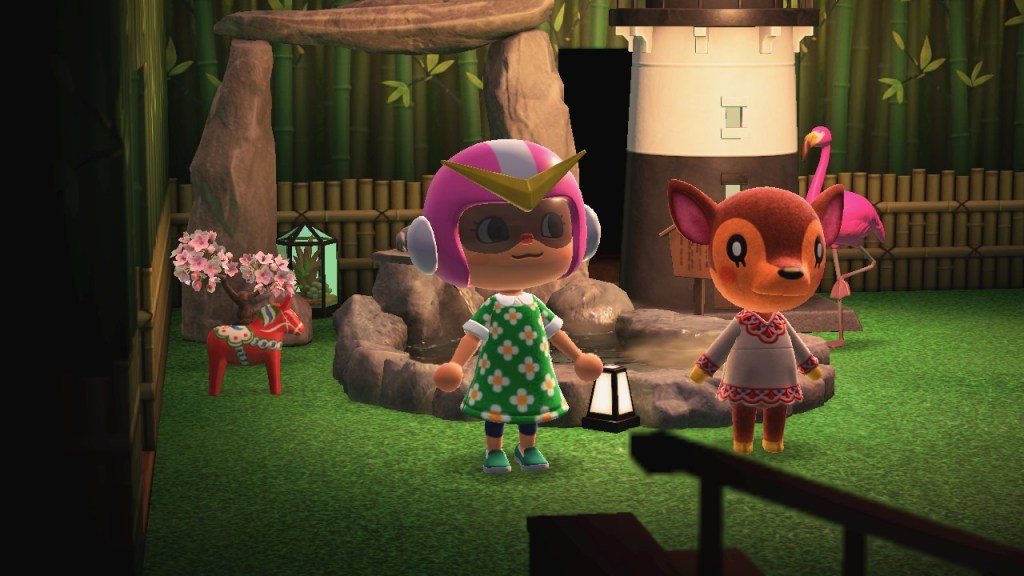
On top of that ACNH is one of these rare games that reinforces players positive behaviour taking a different, progressive stance on toxicity issues. ACNH is not focusing on just preventing player’s toxic behaviour, here players are rewarded for being nice to each other, for inviting each other to visit and for sending lovely gifts. In this game you can’t steal someone’s furniture, but the guest can pick it up and drop for you so you can take it with you when you leave. This is helping players’ communities bloom, be it to make your friends benefit from the best turnip price or to trade a tier 1 villager. People become nice as habit and will leave tips and prezzies after visiting as a gesture to thank their turnip seller host.
But sadly it’s not just about friendship, something else at the core of the players progression ties the game into a consistent player experience and that’s Bells. So how do you progress in Animal Crossing?
Well for me, that’s the sad part, you progress through a very cute debt system where Bells are your holy grail.
Remember the very start of the game? You are purchasing a vacation package, deciding to isolate on a deserted island and get a true experience of the wild. After that the game starts and your goal is to make the island prettier and more hospitable for yourself and the thriving community of NPCs that will gradually appear. To achieve that, the first step (and there is no avoiding it) it to take up a huge loan from Tom Nook (read Tanuki Mega Lord). From then on, your main motivation is to pay back this initial debt, then take on a new one to improve either your house or the island infrastructure, and so on and so forth.
As in John Locke‘s vision, everything that nature provides and that is not the private property of another person is yours to claim. Everything that you can collect on the island is yours to sell and help pay back Nook services. You collect bugs and fruits and pick up the “weeds” as they are not desirable, not even permitted, if you want to achieve one day the island top star rating. So what players do is basically appropriate and “rearrange” that nature and wilderness they came in to seek, to replace it with paved streets and snack machines, all purchased with the Bells acquired selling nature’s goods. In Animal Crossing there is only one way forward and that’s Capitalism.
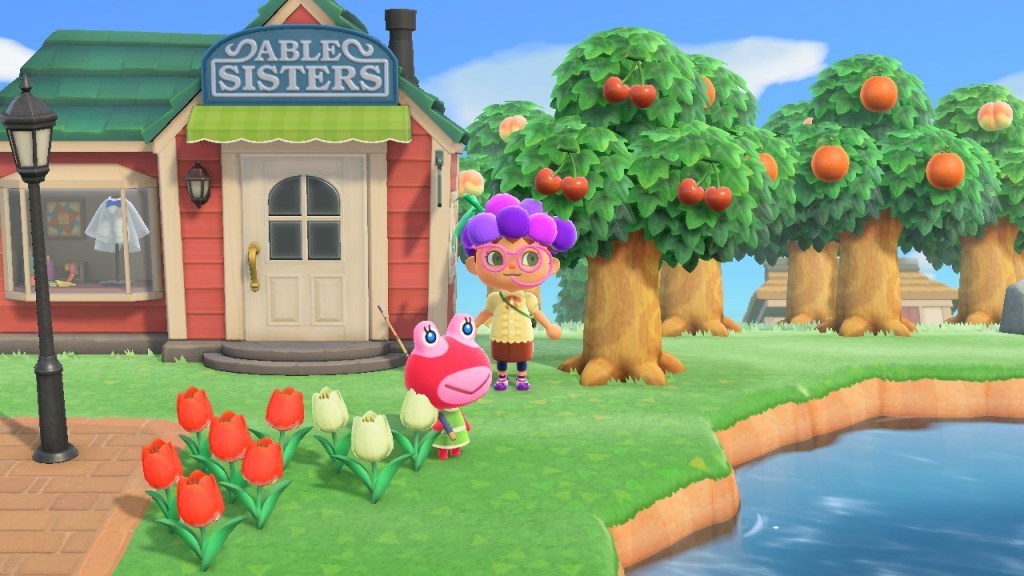
The game teaches you to borrow money and to work to pay it back, the island evaluation system will reward islands where the player has build fences and infrastructures, where villagers’ delimited gardens are stuffed with cute BBQ and retro dinners chairs. Pastoralism, minimalism or ecology goes against your progression. In New Horizons, like in our modern world, social status is acquired through the accumulation of goods. Of course, purchased furniture will grant you more points than DIY and the most expensive the better! For those who miss the thrill of the stock exchange, there is even Daisy Mae who grants you access to the Stalk exchange where you bid on the price of turnips driving players to build additional rooms only to store the most pricey root vegetable there is and get a chance to become a multi millionaire. There is even a loyalty program called Nook Miles, where the more you spend the more you are given points you can then use to buy say, travel tickets to other deserted islands and scavenge all their fruits and minerals to make more Bells.
Thanks to these features, no one can say there is nothing to do anymore because there is always a way to earn Miles with the never ending daily challenges. Wasn’t it a nice message though to have nothing to do on this little island? Shouldn’t we encourage players to do more of nothing and be creative on their own and contemplate the little things rather than act according to what will bring them Bells or Miles?
At one point players can even terraform their land, you no longer just do the best with what you’re given but now you’re so mighty you can completely alter it to your will without much second thoughts.
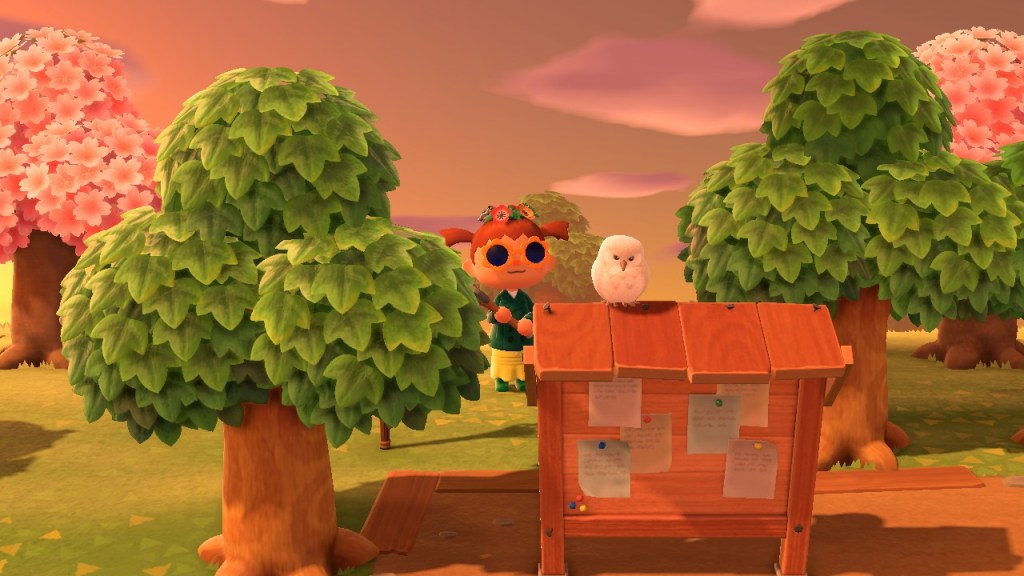
Despite this Lockean idea, ACNH tries to instill in its players a notion that respecting and supporting nature is important (again it’ll reward you in Nook Miles). On Earth week for example, it encouraged players to plant fruit trees and seed flowers. The problem is that the 2 hardly coexist as the reward is always in the form of a currency. In the same week players were rewarded for weeding and cutting trees just as much as they were for planting them, and their motivation in both scenarios is to earn Miles, not do what’s respectful of the environment or to see something cool that would come from nature, the island or Earth. There is no penalty for leaving trash on the beach, and players are encouraged to colonize their whole island and leave nothing untouched, because if you don’t, well nothing new or exciting really happens, you don’t attract villagers or visitors and the untouched area doesn’t evolve or reward you like the altered area does.
Why not use this opportunity to truly inform players and reward positive respectful behaviour that they will then transfer to their daily habits? The game feels to me like a missed opportunity to inform and reflect on our society and its priorities in a fun way. Why not encourage players to leave a space of their deserted island truly untouched and see what magic could happen there? Why do we have to act on this deserted island as if we owned it all like most people do already in real life and has lead us to the catastrophic state in which our planet is in?
I wish the game did not just pretend to care about the ecology but provided an opportunity to illustrate a cohabitation between the nature and the human-built world. I wish the game would hint at the rewards of working with nature and get inspiration from it rather than encourage us to keep building and accumulating more and more. Isn’t it time yet for games to suggest an alternative to our money and status seeking societies? The very controversial game Mountain, back in 2014 excited and fascinated us writers with its ambient melancholic internal dialogue. It encouraged its players, or passive witnesses of the seasons to feel for this mountain where cars and garbage come and crash down from nowhere. A game as successful as New Horizons, played by millions of players both young and fully developed adults, presents such a huge potential to touch players and ask today’s central question of the impact and responsibility of our life styles on the state of our home, our once upon a time deserted island.
Animal Crossing first appears as the cute getaway from daily life only to play by the same old rules. It reinforces the standards and values that have lead us to behave as if we didn’t have to share our planet with other species. It is a relaxing escape in this time of pandemic but only if you don’t think too much of what its reward system subconsciously trains us to consider progress.
 Amélie Beaudroit
Leave a comment